
Tellicherry Black Pepper
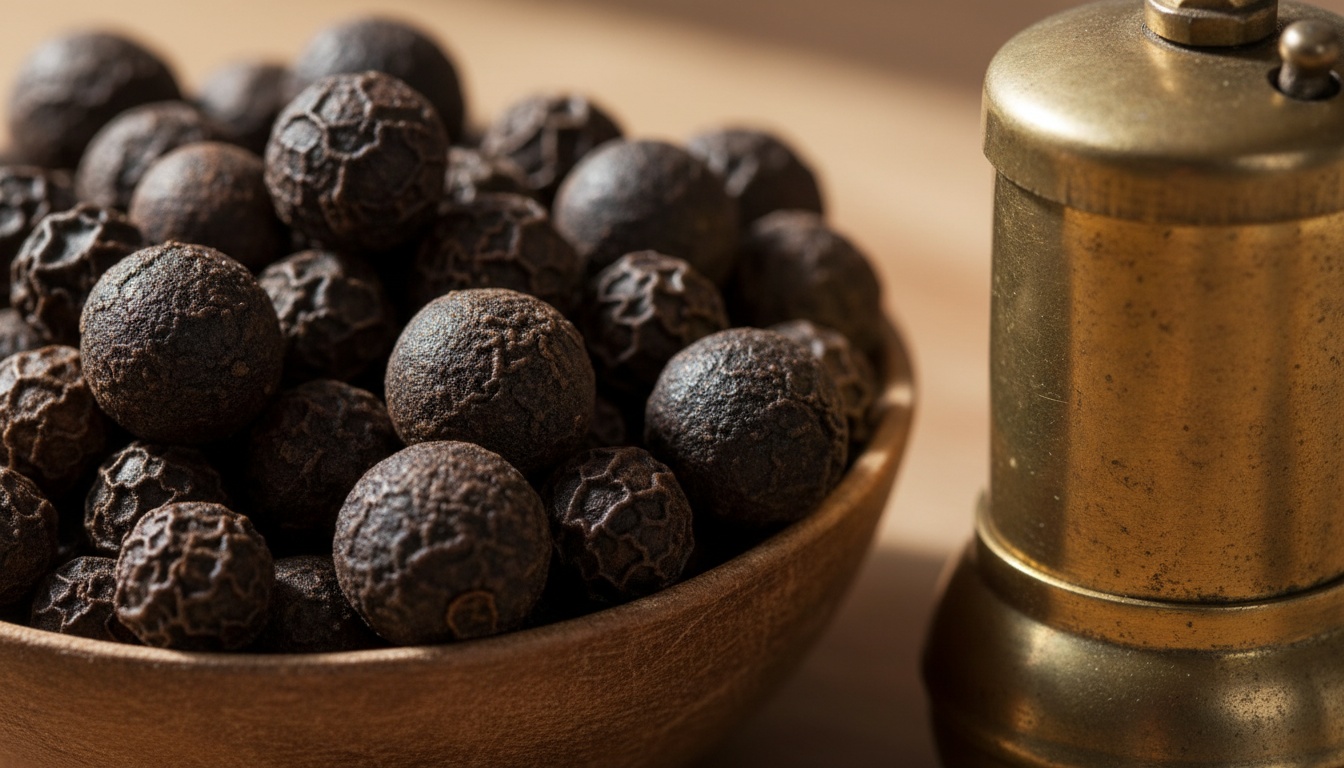
TGSEB — the bold berry, 550–570 g/l
Tellicherry is not a different plant from ordinary black pepper — it is the same Malabar vine, and what makes it Tellicherry is size selection. The berries are left to mature longer on the vine and then graded, so only the largest are taken: TGEB (Tellicherry Garbled Extra Bold) at 4.25 mm minimum, and TGSEB (Garbled Special Extra Bold) at 4.75 mm minimum, against roughly 3.5–4 mm for standard grades. Bulk density runs 550–570 g/l, moisture ≤ 12%, light berries ≤ 2%, extraneous matter ≤ 0.5%, with piperine typically 4–6% and volatile oil 2–4%. That longer maturation is what buys the aroma as well as the size: bigger, later-picked berries carry more volatile oil, which is the fragrance you notice when the mill turns.
Buy Tellicherry where the pepper is tasted rather than merely used: table and grinder retail at premium price points, fine dining and specialist food-service, gourmet and provenance-branded packs, and any application where the aroma at the point of grinding is part of the product. Buy Malabar Garbled MG1 instead for food processing, industrial seasoning, general kitchen use and anywhere the pepper is cooked into a dish — it is the same species with a smaller berry and materially cheaper, and in a cooked application the difference largely disappears. The one thing to hold suppliers to is that Tellicherry is a size grade with a defined minimum, not a marketing adjective: contract TGEB or TGSEB by name with the berry-size and bulk-density figures attached, because "Tellicherry" is applied loosely to pepper that would not pass the screen. CBIL supplies against SGS or Intertek certification of berry size, bulk density, moisture, light berries, volatile oil and extraneous matter, in 25 kg bags, container-load, on FOB, CFR and CIF terms.
Indicative reference
$4,800–6,800 USD / MT
as at September 2026
Reference level only — not an offer, and reviewed quarterly. Levels shown are as at September 2026. Firm pricing is quoted per RFQ, subject to volume, terms and inspection.
Typical Specification
Specifications are indicative and adjusted to the agreed contract and destination requirements. Final spec confirmed on COA / SGS.
Available Grades
Applications
- Premium table & grinder retail
- Fine dining & specialist food-service
- Gourmet & provenance packs
- Whole-berry presentation
- Premium spice blends
Category
Agri-Foods, Spices & Nuts
Incoterms
FOB · CFR · CIF
Pricing basis
USD / MT
Inspection
SGS / Intertek at load port
Tellicherry Black Pepper — buyer questions
Is Tellicherry a different variety of pepper?
No — same vine, same species. Tellicherry is a size grade: berries left longer on the vine and then screened, with TGEB at 4.25 mm minimum and TGSEB at 4.75 mm against roughly 3.5–4 mm for standard grades. The longer maturation also raises volatile oil, so the aroma difference is real, but you are buying selection rather than a different plant.
Is it worth the premium over Malabar MG1?
It depends entirely on whether the pepper is tasted at the point of use. For a grinder on a table or a gourmet retail pack, the berry size and the aroma when it grinds are the product and the premium is justified. For pepper cooked into a sauce or a processed food, most of that advantage is lost in the pot and MG1 does the same job for considerably less.
How do I stop being sold ordinary pepper as Tellicherry?
Contract the grade code and the numbers, not the name. Specify TGEB or TGSEB with berry-size minimum and bulk density in g/l, and have both certified at load port. "Tellicherry" is used loosely across the trade for pepper that would not pass the screen, and bulk density is the quickest practical check — 550–570 g/l is hard to fake.
Do I need steam-sterilised material?
If it is going into ready-to-eat food or a market with microbiological limits at retail, yes. Steam sterilisation reduces microbial load without the irradiation that some markets and brands refuse. It costs more and can slightly reduce volatile oil, so specify it only where your application or regulator requires it rather than as a default.
Ready to source Tellicherry Pepper?
Send your quantity, specification, preferred Incoterms and destination port. We'll verify supply and respond with a workable offer — usually within one business day.
Have Tellicherry Pepper to sell? Submit an offer — we'll match it against live buyer demand.
More in Spices
Turmeric
Fingers, bulbs & powder by curcumin percentage
Red Chilli
Teja, Byadgi & Guntur by ASTA colour and heat
Cumin Seeds
Singapore & Europe quality, 99/1 and 99/2 purity
Coriander Seeds
Eagle & Scooter grades, single and double parrot
Black Pepper
Malabar Garbled, TGSEB & white pepper by density
Fennel Seeds
Bold green Lucknowi & Europe-quality saunf
Fenugreek Seeds
Methi seed for spice, extraction & nutraceutical use
Cardamom
Green 8mm bold & black cardamom by capsule size
Teja Chilli (S17)
75,000–100,000 SHU — the pungency grade
Byadgi Chilli
ASTA colour 45–90, low heat — the colour grade
Guntur Sannam Chilli (S4)
S4 / 334 at 25,000–40,000 SHU — the volume grade
Kashmiri Chilli
Deep red, barely hot — ASTA 60–80 at 1,500–2,000 SHU
Alleppey Finger Turmeric
3.5–5.5% curcumin — the extraction grade
Erode & Salem Finger Turmeric
2.5–3.5% curcumin, bright yellow — the culinary grade
Malabar Black Pepper (MG1)
MG1 at 500–550 g/l — the volume trade grade
White Pepper
Decorticated 600–620 g/l — heat without dark specks
Green Cardamom
8mm AGEB bold — graded on size & colour
Black Cardamom (Badi Elaichi)
Fire-dried, smoky — a different species entirely