
Byadgi Chilli
ASTA colour 45–90, low heat — the colour grade
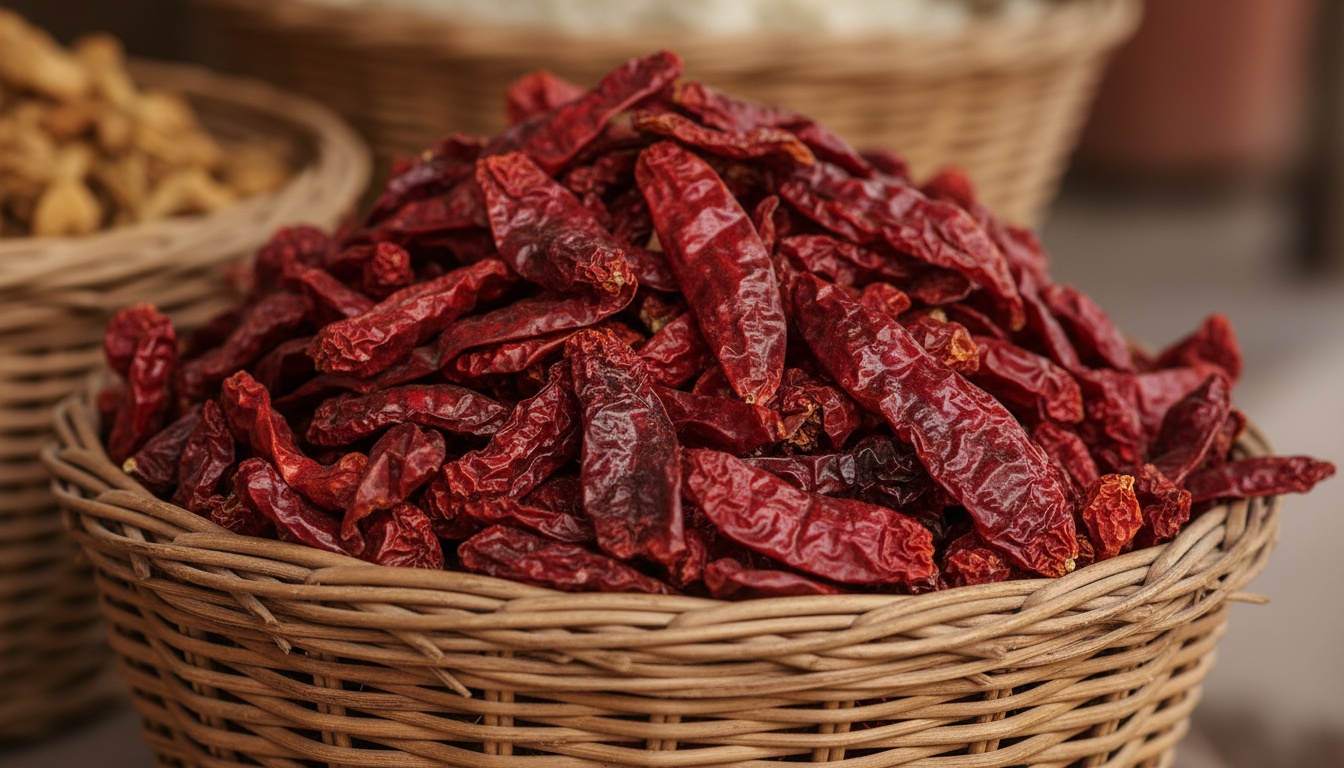
Byadgi is the colour chilli, and it exists commercially because deep red and mild are a combination most chillies cannot deliver. Extractable colour runs ASTA 45–90 — the top of the Indian range — against pungency of only 8,000–15,000 SHU, roughly a tenth of Teja. The pods are characteristically wrinkled and dark, grown around Byadgi and Haveri in Karnataka, and the trade splits them two ways: Kaddi is the longer, thinner pod, while Dabbi is shorter and thicker and generally carries higher colour, which is why extractors bid for it specifically. Moisture runs ≤ 10%, with aflatoxin at the EU limits of 5 ppb B1 and 10 ppb total, and damaged and broken pods contracted at ≤ 3%.
Buy Byadgi when the dish or the product must look red without being hot: oleoresin colour extraction, natural food colourants, paprika-style powders, sambhar and curry blends across South India, and processed food where visual appeal is doing the work. That colour-without-heat property is also why it substitutes for paprika in many industrial applications at a competitive cost. Where it is wrong is anywhere pungency is the point — a hot sauce built on Byadgi will look magnificent and taste flat, and Teja is the answer there. One honest note on labelling: a good deal of chilli sold into retail as "Kashmiri" is in fact Byadgi, because genuine Kashmiri supply is small and the two look similar. If your programme specifically requires Kashmiri, contract it by name and verify it, because the substitution is common. CBIL supplies against SGS or Intertek certification of ASTA colour, SHU, moisture, aflatoxin, residues and foreign matter, in 25 kg jute or PP bags, container-load, on FOB, CFR and CIF terms.
Indicative reference
$2,400–3,600 USD / MT
as at September 2026
Reference level only — not an offer, and reviewed quarterly. Levels shown are as at September 2026. Firm pricing is quoted per RFQ, subject to volume, terms and inspection.
Typical Specification
Specifications are indicative and adjusted to the agreed contract and destination requirements. Final spec confirmed on COA / SGS.
Available Grades
Applications
- Oleoresin colour extraction
- Natural food colourants
- Paprika-style powders
- Sambhar & curry blends
- Processed food colouring
Category
Agri-Foods, Spices & Nuts
Incoterms
FOB · CFR · CIF
Pricing basis
USD / MT
Inspection
SGS / Intertek at load port
Byadgi Chilli — buyer questions
Kaddi or Dabbi?
Dabbi if colour is the priority — the shorter, thicker pod generally carries higher ASTA and extractors bid for it specifically. Kaddi, the longer thinner pod, is the more available and usually cheaper of the two and serves culinary blending well. If you are running an extraction line, specify Dabbi and an ASTA floor rather than ordering Byadgi generically.
Can Byadgi replace paprika?
In many industrial colour applications, yes — that is a real part of its market. It delivers comparable extractable colour at a competitive cost, with a mild pungency that paprika does not have but which is low enough not to matter in most formulations. Test against your specific application first: the flavour profile is not identical even though the colour function is.
Is Byadgi the same as Kashmiri chilli?
No, though a great deal of retail "Kashmiri" chilli is actually Byadgi. Genuine Kashmiri is a distinct and much scarcer variety with even lower pungency and its own colour profile; Byadgi is grown in Karnataka in far larger volume and looks similar. The substitution is widespread. If your specification says Kashmiri, contract it by name and verify — otherwise expect Byadgi.
What ASTA colour should I specify?
Work back from your product. 45–60 covers most culinary and blending uses. 60–90 is what colour extractors and natural-colourant manufacturers want, and it commands a real premium. Nominate a floor rather than a range, because ASTA is the price driver here in the way SHU is for Teja, and a vague specification invites the lowest-colour lot that technically qualifies.
Ready to source Byadgi Chilli?
Send your quantity, specification, preferred Incoterms and destination port. We'll verify supply and respond with a workable offer — usually within one business day.
Have Byadgi Chilli to sell? Submit an offer — we'll match it against live buyer demand.
More in Spices
Turmeric
Fingers, bulbs & powder by curcumin percentage
Red Chilli
Teja, Byadgi & Guntur by ASTA colour and heat
Cumin Seeds
Singapore & Europe quality, 99/1 and 99/2 purity
Coriander Seeds
Eagle & Scooter grades, single and double parrot
Black Pepper
Malabar Garbled, TGSEB & white pepper by density
Fennel Seeds
Bold green Lucknowi & Europe-quality saunf
Fenugreek Seeds
Methi seed for spice, extraction & nutraceutical use
Cardamom
Green 8mm bold & black cardamom by capsule size
Teja Chilli (S17)
75,000–100,000 SHU — the pungency grade
Guntur Sannam Chilli (S4)
S4 / 334 at 25,000–40,000 SHU — the volume grade
Kashmiri Chilli
Deep red, barely hot — ASTA 60–80 at 1,500–2,000 SHU
Alleppey Finger Turmeric
3.5–5.5% curcumin — the extraction grade
Erode & Salem Finger Turmeric
2.5–3.5% curcumin, bright yellow — the culinary grade
Tellicherry Black Pepper
TGSEB — the bold berry, 550–570 g/l
Malabar Black Pepper (MG1)
MG1 at 500–550 g/l — the volume trade grade
White Pepper
Decorticated 600–620 g/l — heat without dark specks
Green Cardamom
8mm AGEB bold — graded on size & colour
Black Cardamom (Badi Elaichi)
Fire-dried, smoky — a different species entirely