
Teja Chilli (S17)
75,000–100,000 SHU — the pungency grade
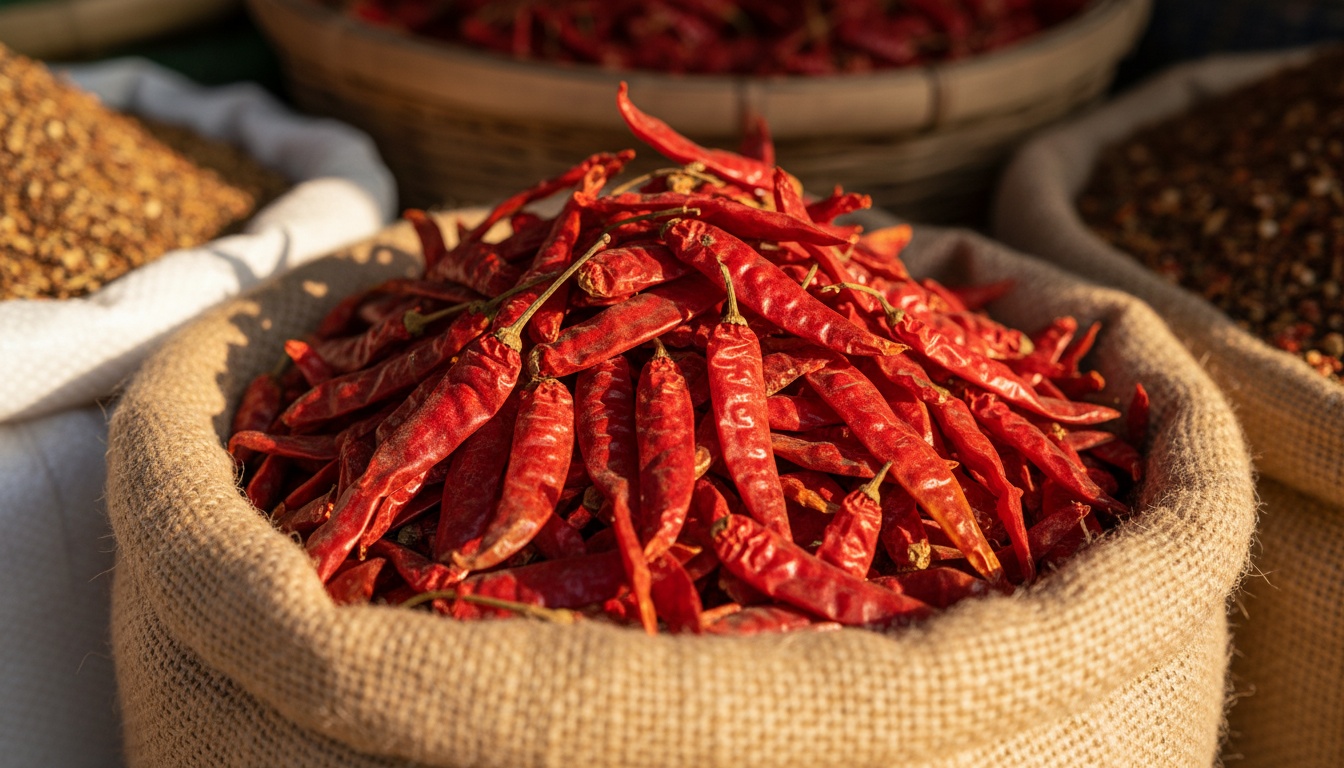
Teja S17 is bought for heat, and Scoville rating is the number that prices it. Pungency runs 75,000–100,000 SHU, which puts it at the hot end of the Indian export range, with ASTA extractable colour of 35–45, pod length 4–6 cm, moisture ≤ 10%, and delivery stemless or with stem depending on whether the buyer is extracting or cooking. Grown principally around Guntur and Warangal in Andhra Pradesh and Telangana, it dominates the Indian chilli export book by volume into China, Bangladesh, Sri Lanka, Indonesia and Vietnam. The specification points that decide acceptance beyond SHU are aflatoxin — chilli is a high-risk crop and the EU limit of 5 ppb B1 and 10 ppb total is where consignments most often fail — plus damaged and broken pods, and residue compliance for the destination.
Buy Teja when pungency is the product: capsaicin and oleoresin extraction, hot sauce and chilli paste manufacture, spice blends and masala where heat is the function, and export markets whose cuisine expects real heat. It is the wrong purchase where colour rather than heat is wanted — Byadgi delivers ASTA colour of 45–90 at a fraction of the pungency and is the correct choice for a colour extraction or a dish that should look red without burning, and Kashmiri sits further along that same axis. The common and expensive mistake is buying on price per tonne across chilli varieties as if they were interchangeable; they are not, and a colour buyer who takes Teja because it was cheaper ends up with an unusable lot. CBIL supplies against SGS or Intertek certification of SHU, ASTA colour, moisture, aflatoxin, pesticide residues and foreign matter, in 25 kg jute or PP bags, container-load, on FOB, CFR and CIF terms.
Indicative reference
$2,000–2,900 USD / MT
as at September 2026
Reference level only — not an offer, and reviewed quarterly. Levels shown are as at September 2026. Firm pricing is quoted per RFQ, subject to volume, terms and inspection.
Typical Specification
Specifications are indicative and adjusted to the agreed contract and destination requirements. Final spec confirmed on COA / SGS.
Available Grades
Applications
- Capsaicin & oleoresin extraction
- Hot sauce & chilli paste
- Masala & spice blends
- High-heat culinary export
- Crushed chilli & flakes
Category
Agri-Foods, Spices & Nuts
Incoterms
FOB · CFR · CIF
Pricing basis
USD / MT
Inspection
SGS / Intertek at load port
Teja Chilli (S17) — buyer questions
Teja or Byadgi — how do I choose?
Decide whether you are buying heat or colour, because they sit at opposite ends. Teja runs 75,000–100,000 SHU with ASTA colour 35–45; Byadgi runs 8,000–15,000 SHU with ASTA colour 45–90. For capsaicin extraction, hot sauce or a genuinely hot dish, Teja. For colour extraction, paprika-style applications or a dish that should look red without burning, Byadgi. They are not interchangeable and price alone is a bad guide.
Stemless or with stem?
Extraction buyers take stemless because stem is inert weight they pay freight on and then have to remove. Culinary and retail buyers often prefer with-stem, which handles and stores slightly better and is the traditional presentation in several markets. Stemless costs more per tonne for the same chilli — you are paying for the labour and the yield, not a different product.
What is the real risk on aflatoxin?
It is the most common reason a chilli consignment is rejected, and the EU limits of 5 ppb B1 and 10 ppb total are strict. Risk builds in the field and during sun-drying, so it is a sourcing and handling question rather than something a certificate fixes after the fact. We work lots that have been properly dried and stored and test at load port — testing on arrival is too late.
Does SHU vary between crops?
Yes, meaningfully. Pungency shifts with growing conditions, crop year and even field, which is why 75,000–100,000 is a band rather than a figure. If your formulation needs a tighter window, say so at enquiry — we can work to a narrower SHU specification, but it narrows the available allocation and prices accordingly.
Ready to source Teja Chilli?
Send your quantity, specification, preferred Incoterms and destination port. We'll verify supply and respond with a workable offer — usually within one business day.
Have Teja Chilli to sell? Submit an offer — we'll match it against live buyer demand.
More in Spices
Turmeric
Fingers, bulbs & powder by curcumin percentage
Red Chilli
Teja, Byadgi & Guntur by ASTA colour and heat
Cumin Seeds
Singapore & Europe quality, 99/1 and 99/2 purity
Coriander Seeds
Eagle & Scooter grades, single and double parrot
Black Pepper
Malabar Garbled, TGSEB & white pepper by density
Fennel Seeds
Bold green Lucknowi & Europe-quality saunf
Fenugreek Seeds
Methi seed for spice, extraction & nutraceutical use
Cardamom
Green 8mm bold & black cardamom by capsule size
Byadgi Chilli
ASTA colour 45–90, low heat — the colour grade
Guntur Sannam Chilli (S4)
S4 / 334 at 25,000–40,000 SHU — the volume grade
Kashmiri Chilli
Deep red, barely hot — ASTA 60–80 at 1,500–2,000 SHU
Alleppey Finger Turmeric
3.5–5.5% curcumin — the extraction grade
Erode & Salem Finger Turmeric
2.5–3.5% curcumin, bright yellow — the culinary grade
Tellicherry Black Pepper
TGSEB — the bold berry, 550–570 g/l
Malabar Black Pepper (MG1)
MG1 at 500–550 g/l — the volume trade grade
White Pepper
Decorticated 600–620 g/l — heat without dark specks
Green Cardamom
8mm AGEB bold — graded on size & colour
Black Cardamom (Badi Elaichi)
Fire-dried, smoky — a different species entirely