
Kashmiri Chilli
Deep red, barely hot — ASTA 60–80 at 1,500–2,000 SHU
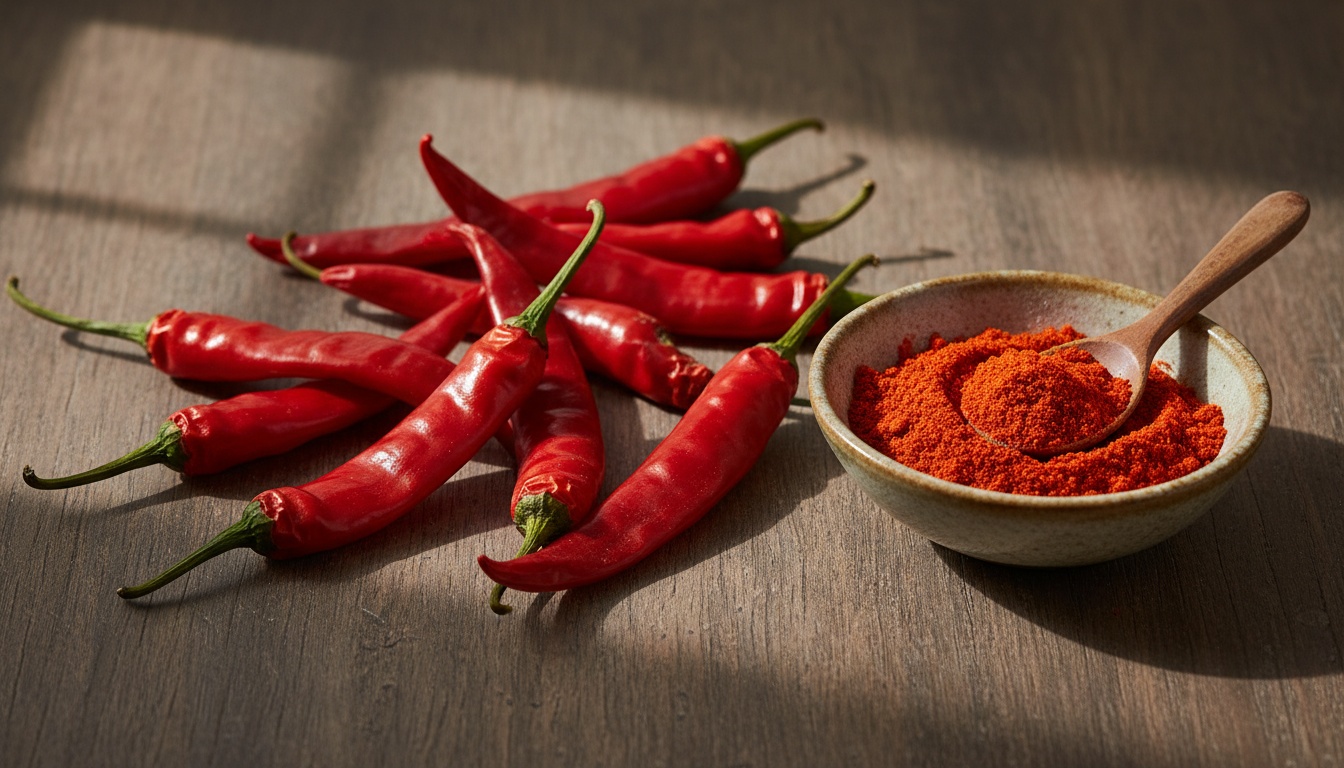
Kashmiri chilli is the mildest of the commercially traded Indian chillies and among the reddest, running ASTA extractable colour of 60–80 against pungency of just 1,500–2,000 SHU — low enough that a dish can be built on it for colour alone without meaningful heat. The pods are broad, deep red and lightly wrinkled, moisture runs ≤ 10%, with aflatoxin to the EU limits and damaged and broken pods at ≤ 3%. It is the chilli behind the colour of rogan josh, tandoori marinades and much of North Indian restaurant cooking, and its reputation is why it carries a substantial premium over every other variety on this list.
The thing a buyer most needs to understand about this product is supply. Genuine Kashmiri acreage is small, the crop is limited, and demand far exceeds it — with the entirely predictable result that a large share of chilli sold as "Kashmiri" in retail and wholesale is Byadgi from Karnataka, which looks similar and costs considerably less. We will not present Byadgi as Kashmiri, and if a quote you are holding from elsewhere looks close to Byadgi pricing, that is what it is. Buy genuine Kashmiri where the name is on the pack, where a restaurant or retail brand is making a provenance claim, or where an unusually low-heat, high-colour profile is functionally required. For volume colour work at sensible cost, Byadgi is the honest answer and we will quote it as Byadgi. CBIL supplies against SGS or Intertek certification of ASTA colour, SHU, moisture, aflatoxin, residues and foreign matter, with origin declaration, in 25 kg bags, container-load, on FOB, CFR and CIF terms.
Indicative reference
$3,200–4,800 USD / MT
as at September 2026
Reference level only — not an offer, and reviewed quarterly. Levels shown are as at September 2026. Firm pricing is quoted per RFQ, subject to volume, terms and inspection.
Typical Specification
Specifications are indicative and adjusted to the agreed contract and destination requirements. Final spec confirmed on COA / SGS.
Available Grades
Applications
- Premium retail chilli powder
- Tandoori & rogan josh marinades
- Restaurant & HORECA supply
- Provenance-branded retail
- Low-heat colour applications
Category
Agri-Foods, Spices & Nuts
Incoterms
FOB · CFR · CIF
Pricing basis
USD / MT
Inspection
SGS / Intertek at load port
Kashmiri Chilli — buyer questions
How do I know I am getting genuine Kashmiri?
Price and paperwork. Genuine Kashmiri carries a substantial premium over Byadgi, so a quote near Byadgi levels is Byadgi. Contract the variety by name with origin declaration and independent verification of ASTA colour and SHU — the pungency figure is the tell, because Kashmiri at 1,500–2,000 SHU is markedly milder than Byadgi at 8,000–15,000.
Why is so much Kashmiri chilli actually Byadgi?
Because demand vastly exceeds a small crop and the two look similar. Kashmiri acreage is limited, so the name has become a category description in much of the retail trade rather than a statement of origin. We do not sell it that way. If Byadgi meets your requirement — and for most colour applications it does — we will quote Byadgi and price it honestly.
Is it worth the premium over Byadgi?
Only for specific reasons. If your pack says Kashmiri, if you are making a provenance claim, or if you genuinely need pungency below 2,000 SHU, then yes. If you need deep red colour at low heat for a blend or an extraction, Byadgi delivers higher ASTA at a materially lower price and the premium buys you nothing your customer will detect.
Is supply reliable for a year-round programme?
Not in the way Sannam or Byadgi is, and we would rather set that expectation now. The crop is small and seasonal. A continuous Kashmiri programme needs early commitment against confirmed allocation, and even then quantities are limited. If you need volume and continuity above all, build the programme on Byadgi and reserve Kashmiri for a premium line.
Ready to source Kashmiri Chilli?
Send your quantity, specification, preferred Incoterms and destination port. We'll verify supply and respond with a workable offer — usually within one business day.
Have Kashmiri Chilli to sell? Submit an offer — we'll match it against live buyer demand.
More in Spices
Turmeric
Fingers, bulbs & powder by curcumin percentage
Red Chilli
Teja, Byadgi & Guntur by ASTA colour and heat
Cumin Seeds
Singapore & Europe quality, 99/1 and 99/2 purity
Coriander Seeds
Eagle & Scooter grades, single and double parrot
Black Pepper
Malabar Garbled, TGSEB & white pepper by density
Fennel Seeds
Bold green Lucknowi & Europe-quality saunf
Fenugreek Seeds
Methi seed for spice, extraction & nutraceutical use
Cardamom
Green 8mm bold & black cardamom by capsule size
Teja Chilli (S17)
75,000–100,000 SHU — the pungency grade
Byadgi Chilli
ASTA colour 45–90, low heat — the colour grade
Guntur Sannam Chilli (S4)
S4 / 334 at 25,000–40,000 SHU — the volume grade
Alleppey Finger Turmeric
3.5–5.5% curcumin — the extraction grade
Erode & Salem Finger Turmeric
2.5–3.5% curcumin, bright yellow — the culinary grade
Tellicherry Black Pepper
TGSEB — the bold berry, 550–570 g/l
Malabar Black Pepper (MG1)
MG1 at 500–550 g/l — the volume trade grade
White Pepper
Decorticated 600–620 g/l — heat without dark specks
Green Cardamom
8mm AGEB bold — graded on size & colour
Black Cardamom (Badi Elaichi)
Fire-dried, smoky — a different species entirely