
Walnuts
Light halves, in-shell & kernel by colour grade
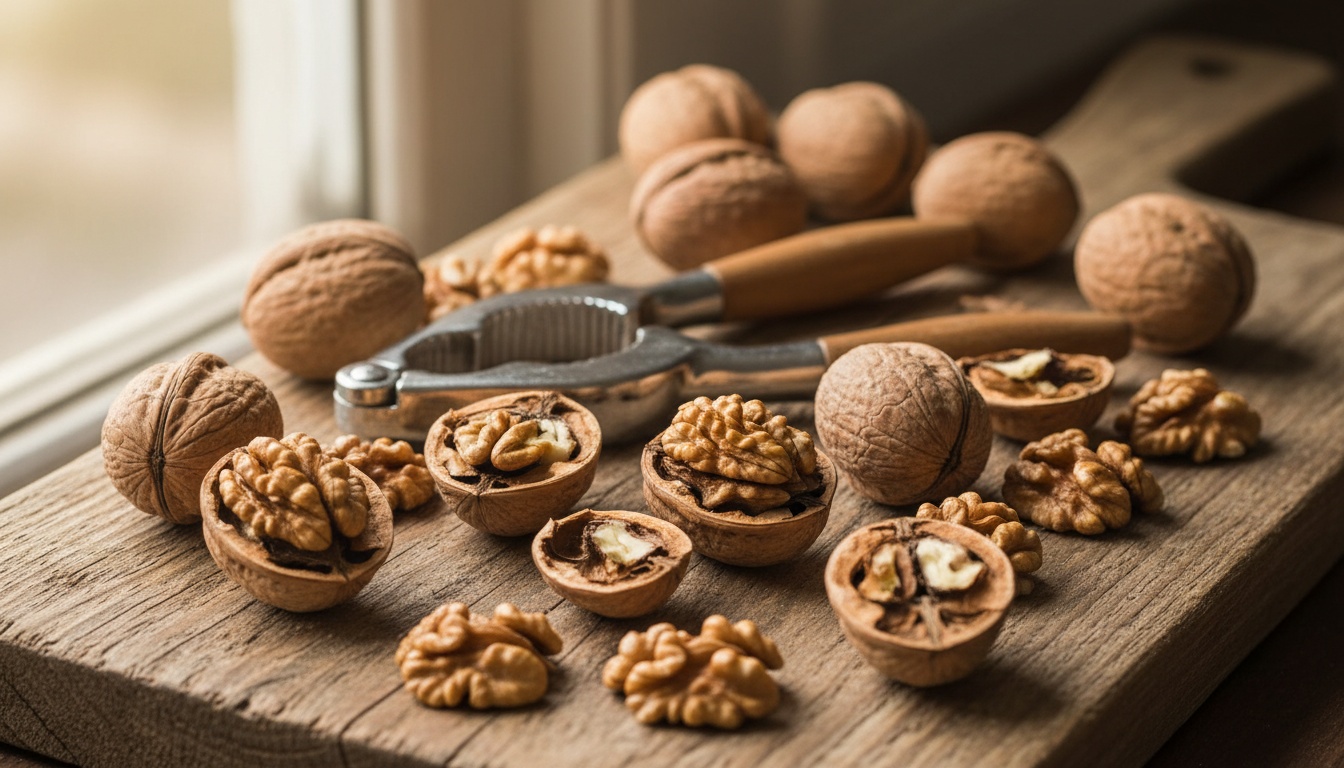
Walnut kernel is graded on colour before anything else, and the colour scale is the price. Extra Light Halves (ELH) sit at the top, then Light Halves (LH), Light Amber (LA) and Amber (A), with each step down a visibly darker kernel and a materially lower number. Colour is not cosmetic vanity — it tracks oxidation of the kernel's very high polyunsaturated oil content, so a darker kernel is generally an older or worse-stored one, and it will go rancid sooner in your finished product. Within colour, the second axis is piece size: halves, quarters, large pieces, small pieces and baking pieces. CBIL arranges Chilean supply (Chandler and Serr, which set the benchmark for light colour), Californian material, Indian kernel from Kashmir and Himachal, and Ukrainian and Moldovan supply into European lanes. In-shell walnuts are a separate contract graded by shell diameter — 30 mm, 32 mm and 34 mm+ — with shell brightness, shell integrity and kernel-to-shell yield (typically 45–50%) as the variables; in-shell is what gifting, festive retail and the Middle East winter trade buy, while food manufacturers buy kernel and never touch a shell.
The decision that matters is colour against process. ELH and LH halves belong in retail packs, gifting, salad toppings, cake decoration and anywhere the kernel faces the customer. Light Amber and Amber pieces are the sensible buy for walnut oil pressing, bakery inclusions, brownies, pesto, ice cream, cereal bars and grinding, where the kernel is broken and browned by the process regardless. Buying ELH halves for a brownie is a spec error that costs real money. Because of the oil content, storage discipline is not optional: we arrange vacuum or nitrogen-flushed packing and reefer stowage on warm lanes, and specify peroxide value and free fatty acid alongside the standard panel. Every lot ships against SGS or Intertek certification of colour grade against the physical standard, moisture at ≤ 8% kernel, aflatoxin to your destination (EU 2 ppb B1 / 4 ppb total for direct consumption against roughly 15 ppb elsewhere), foreign matter, shell fragments and rancidity markers, with phytosanitary documentation. Supply is arranged in 10 kg and 22.68 kg vacuum cartons for kernel and 10 / 20 kg cartons for in-shell, container-load, on FOB, CFR and CIF terms.
Indicative reference
$5,400–7,600 USD / MT
as at September 2026
Reference level only — not an offer, and reviewed quarterly. Levels shown are as at September 2026. Firm pricing is quoted per RFQ, subject to volume, terms and inspection.
Typical Specification
Specifications are indicative and adjusted to the agreed contract and destination requirements. Final spec confirmed on COA / SGS.
Available Grades
Applications
- Retail packing & gifting (in-shell)
- Bakery & confectionery inclusions
- Salad, cereal & snack toppings
- Walnut oil pressing
- Ice cream & dairy
Category
Agri-Foods, Spices & Nuts
Incoterms
FOB · CFR · CIF
Pricing basis
USD / MT
Inspection
SGS / Intertek at load port
Walnuts — buyer questions
What does 'light halves' mean and why does it cost more?
It is a colour grade against a physical standard — Extra Light Halves, Light Halves, Light Amber, Amber, in descending order of price. Colour tracks oxidation of the kernel's very high polyunsaturated oil, so a lighter kernel is generally fresher and better stored and will hold longer in your product. You are buying appearance and shelf-life together, not just looks.
Should I buy in-shell walnuts or kernel?
In-shell is for gifting, festive retail and the Middle East winter trade, and is graded by shell diameter — 30, 32, 34 mm+ — with kernel yield around 45–50%. Food manufacturers buy kernel: you are otherwise paying ocean freight on shell you will throw away, then paying to crack it. Unless the shell is part of the sale, buy kernel.
When are amber pieces the right buy?
Whenever the kernel gets broken and browned by your process anyway — brownies and bakery inclusions, pesto, ice cream, cereal bars, walnut oil pressing, grinding. The colour premium buys you nothing there. Save ELH and LH halves for retail packs, salad toppings and decoration where the customer sees each kernel.
How do I stop walnuts going rancid before end of shelf-life?
Start with colour grade, then control oxygen and heat. We arrange vacuum or nitrogen-flushed packing and reefer stowage on warm lanes, and specify peroxide value and free fatty acid on the COA alongside the standard panel. Walnut oil oxidises faster than almond or cashew, so a lot that ships loose-packed through a hot lane can arrive technically in-grade and still fail your shelf-life trial.
Ready to source Walnuts?
Send your quantity, specification, preferred Incoterms and destination port. We'll verify supply and respond with a workable offer — usually within one business day.
Have Walnuts to sell? Submit an offer — we'll match it against live buyer demand.
More in Dry Fruits & Nuts
Cashew Nuts
W180 to W450 wholes, plus SW, butts, splits & LWP
Almonds
Nonpareil, Independence, Carmel & Mamra by count per ounce
Pistachios
Iranian & Californian, open-shell by count per ounce
Dates
Medjool, Ajwa, Safawi & Zahidi by grade and moisture
Dried Figs
Turkish Lerida & Natural by diameter grade
W320 Cashew Kernels
300–320 kernels/lb — the world benchmark grade
Premium Whole Cashews (W180 / W210 / W240)
170–240 kernels/lb — the gifting & premium retail sizes
Cashew Pieces & Splits
LWP, SWP, butts & splits — the processing grades
Nonpareil Almonds
California's premium variety — clean blanching, uniform kernel
California Type Almonds
Carmel, Monterey & Independence — the volume grades
Mamra Almonds
Iranian & Afghan wild-type — oil-rich, low yield, premium
Akbari Pistachios
Iran's longest kernel — 18/20 & 20/22 jumbo
Fandoghi Pistachios (Round)
Round 28/30 & 30/32 — Iran's volume variety
Kerman Pistachios (California)
California's dominant cultivar — 21/25 & 24/28
Walnut Kernels
Colour-graded ELH to Amber — halves, quarters & pieces
In-Shell Walnuts
30 mm, 32 mm & 34 mm+ — Chandler & Hartley