
Almonds
Nonpareil, Independence, Carmel & Mamra by count per ounce
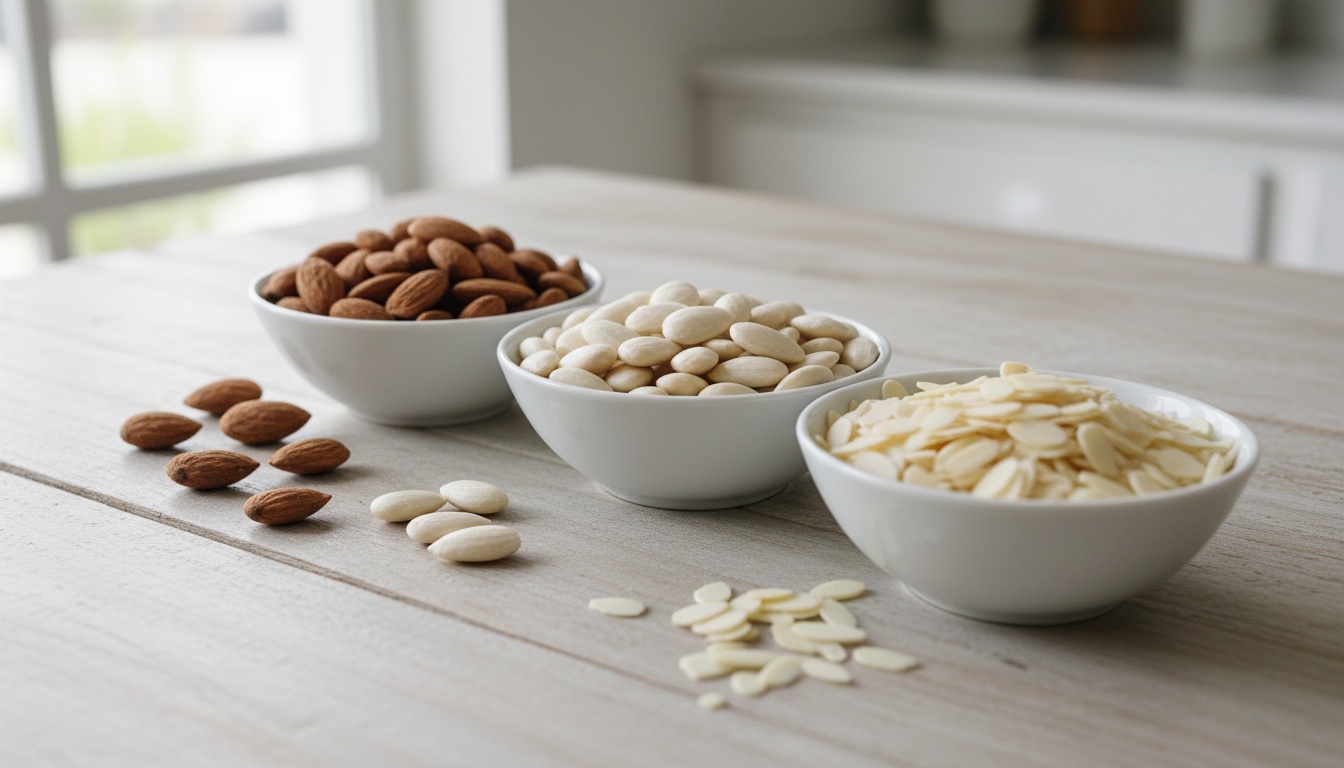
Almonds are contracted on two axes that buyers routinely conflate: variety type and count per ounce. Variety sets the shape, skin and how the kernel behaves — Nonpareil is the flat, smooth-skinned, thin-shelled premium type that blanches and slices cleanly and is what you specify when the kernel is visible; Independence is a self-fertile Nonpareil-type that has taken over new Californian plantings and delivers close appearance at a lower cost; Carmel sits in the California type group with a wrinklier skin, well suited to roasting, coating and grinding where appearance does not carry; and Mamra from Iran and Afghanistan is a genuinely different product — small, dense, high-oil, hand-cracked, sold at a large premium into South Asian and Middle Eastern gifting and ayurvedic demand rather than competing with Californian pool material at all. Count per ounce is the size language on top of variety: 18/20 and 20/22 are the bold counts, 23/25 and 25/27 are the mainstream sizes, 27/30 and 30/32 are small and price lower. Fewer nuts to the ounce means a bigger kernel and a higher price.
What you are actually deciding is whether appearance survives your process. Nonpareil 20/22 in a retail nut pack, on a chocolate bar or in a blanched slivered line earns its premium because every kernel is seen. The same nut in almond flour, marzipan, praline, almond milk or a coated snack is money burned — Carmel, California-type pool material or even shelled seconds do the identical job. CBIL arranges Californian supply alongside Australian, Spanish and Iranian/Afghan Mamra, with SGS or Intertek certification of count per ounce, moisture at ≤ 6%, chipped-and-scratched and doubles percentage, foreign matter, aflatoxin, and — where the destination requires it — pasteurisation status, since the US mandates a validated pasteurisation step for almonds sold domestically and many EU buyers now specify it too. Aflatoxin again splits the market: EU limits for direct-consumption nuts sit at 2 ppb B1 / 4 ppb total against roughly 15 ppb total elsewhere, and we write the limit to your destination. Kernels ship in 22.68 kg (50 lb) cartons, vacuum packs and nitrogen-flushed formats, container-load, on FOB, CFR and CIF terms.
Indicative reference
$6,300–8,200 USD / MT
as at September 2026
Reference level only — not an offer, and reviewed quarterly. Levels shown are as at September 2026. Firm pricing is quoted per RFQ, subject to volume, terms and inspection.
Typical Specification
Specifications are indicative and adjusted to the agreed contract and destination requirements. Final spec confirmed on COA / SGS.
Available Grades
Applications
- Retail packing & gifting
- Chocolate & confectionery
- Bakery, marzipan & praline
- Almond milk & flour
- Roasted & salted snack nuts
Category
Agri-Foods, Spices & Nuts
Incoterms
FOB · CFR · CIF
Pricing basis
USD / MT
Inspection
SGS / Intertek at load port
Almonds — buyer questions
What does an almond count like 23/25 mean?
It is the number of kernels per ounce — 23 to 25 in this case. Fewer nuts per ounce means a bigger kernel and a higher price. 18/20 and 20/22 are the bold counts for retail and confectionery display; 23/25 and 25/27 are the mainstream sizes; 27/30 and 30/32 are small and price lower without any difference in kernel quality.
Is Nonpareil worth the premium over Carmel or Independence?
Only if the kernel is seen. Nonpareil is flat, smooth-skinned and blanches and slices cleanly, so it earns its money in retail packs, chocolate and slivered lines. For almond flour, marzipan, praline, almond milk or a coated snack, Carmel or California-type pool material performs identically and costs materially less. Independence sits between the two and is worth quoting alongside Nonpareil.
What is Mamra and why is it so much more expensive?
Mamra is a small, dense, high-oil almond from Iran and Afghanistan, largely hand-cracked, sold into South Asian and Middle Eastern gifting and ayurvedic demand. It is not a substitute for Californian material and does not compete with it on price — it is a separate market with its own buyers. If you are quoting Mamra against Nonpareil, you are comparing two different products.
Do almonds need to be pasteurised?
For the US domestic market a validated pasteurisation step is mandatory, and a growing number of EU retail programmes now specify it as well. Pasteurisation is a Salmonella control and does not change the count or grade. Tell us the destination and the end use and we will write the treatment status into the spec — raw material still has legitimate markets, but not all of them.
Ready to source Almonds?
Send your quantity, specification, preferred Incoterms and destination port. We'll verify supply and respond with a workable offer — usually within one business day.
Have Almonds to sell? Submit an offer — we'll match it against live buyer demand.
More in Dry Fruits & Nuts
Cashew Nuts
W180 to W450 wholes, plus SW, butts, splits & LWP
Walnuts
Light halves, in-shell & kernel by colour grade
Pistachios
Iranian & Californian, open-shell by count per ounce
Dates
Medjool, Ajwa, Safawi & Zahidi by grade and moisture
Dried Figs
Turkish Lerida & Natural by diameter grade
W320 Cashew Kernels
300–320 kernels/lb — the world benchmark grade
Premium Whole Cashews (W180 / W210 / W240)
170–240 kernels/lb — the gifting & premium retail sizes
Cashew Pieces & Splits
LWP, SWP, butts & splits — the processing grades
Nonpareil Almonds
California's premium variety — clean blanching, uniform kernel
California Type Almonds
Carmel, Monterey & Independence — the volume grades
Mamra Almonds
Iranian & Afghan wild-type — oil-rich, low yield, premium
Akbari Pistachios
Iran's longest kernel — 18/20 & 20/22 jumbo
Fandoghi Pistachios (Round)
Round 28/30 & 30/32 — Iran's volume variety
Kerman Pistachios (California)
California's dominant cultivar — 21/25 & 24/28
Walnut Kernels
Colour-graded ELH to Amber — halves, quarters & pieces
In-Shell Walnuts
30 mm, 32 mm & 34 mm+ — Chandler & Hartley