
Cashew Nuts
W180 to W450 wholes, plus SW, butts, splits & LWP
The W number on a cashew contract is not a quality score — it is a count. W320 means roughly 300–320 kernels to the pound (about 660–705 per kg), so a lower number is a physically bigger nut: W180 is around 170–180 per pound and is the largest, rarest whole grade, W450 is around 400–450 and the smallest. Size drives price almost linearly because bigger kernels are a smaller fraction of any given crop, not because they taste different. CBIL brokers the full ladder against AFI grading language: white wholes W180, W210, W240, W320 and W450; scorched wholes (SW, SW-2) where a heat mark during roasting has darkened the kernel without touching flavour; butts (B) and splits (S), where the kernel has broken along or across its natural cleft; and large white pieces (LWP), small white pieces (SWP) and baby bits at the bottom of the stack. Supply is arranged from Vietnamese processors (the world's volume centre, largely reprocessing West African raw nut) and Indian processors in Kollam, Mangalore and Panruti, with SGS or Intertek certification of count per pound, moisture at ≤ 5%, broken and defective percentage, foreign matter, aflatoxin and microbiological load including Salmonella-absent status.
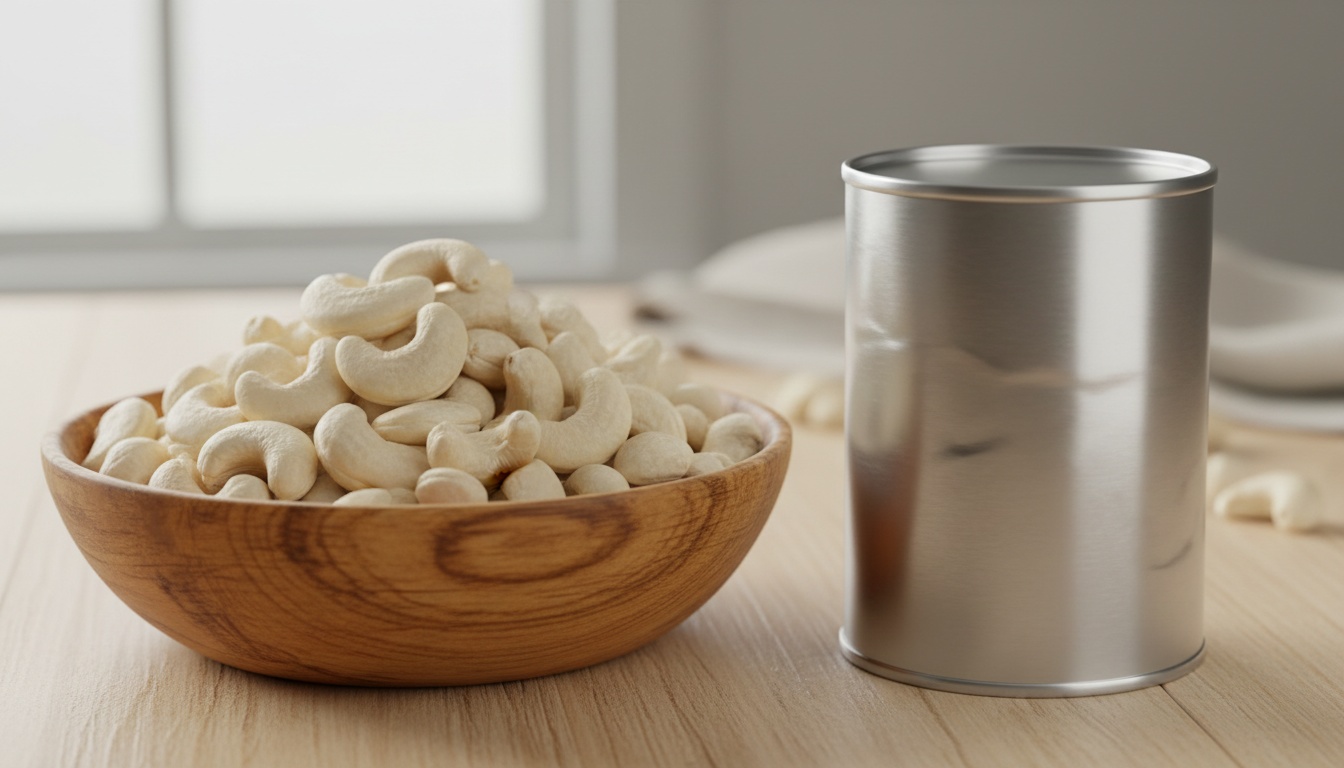
Specify by what the kernel has to do, not by prestige. W180 and W240 are for whole-nut retail packs, gifting tins, cocktail nuts and anywhere the individual nut is inspected — you are buying appearance. W320 is the global workhorse and the grade most cashew price talk actually refers to. W450 delivers identical kernel at a discount where nuts are salted and mixed. Below that, SW is a genuine bargain when the nut is being roasted, coated or milled — the scorch is cosmetic, and buyers who reject it for a coated product are paying a premium to hide a mark under chocolate. Butts, splits and LWP are the honest choice for cashew butter, praline, ice cream inclusions, bakery and confectionery filling, where an intact kernel is destroyed in the first process step anyway. Aflatoxin governs your entry: the EU works to 2 ppb B1 / 4 ppb total for nuts intended for direct consumption, while many other destinations accept 15 ppb total — the split is worth 10–20% on landed cost, so we write the limit to the actual destination rather than over-specifying. Kernels ship vacuum-packed or nitrogen-flushed in 22.68 kg (50 lb) tins and cartons, container-load, on FOB, CFR and CIF terms.
Indicative reference
$7,200–9,400 USD / MT
as at September 2026
Reference level only — not an offer, and reviewed quarterly. Levels shown are as at September 2026. Firm pricing is quoted per RFQ, subject to volume, terms and inspection.
Typical Specification
Specifications are indicative and adjusted to the agreed contract and destination requirements. Final spec confirmed on COA / SGS.
Available Grades
Applications
- Retail packing & gifting tins
- Roasted & salted snack nuts
- Cashew butter & praline
- Bakery, confectionery & ice cream inclusions
- HORECA
Category
Agri-Foods, Spices & Nuts
Incoterms
FOB · CFR · CIF
Pricing basis
USD / MT
Inspection
SGS / Intertek at load port
Cashew Nuts — buyer questions
What does W320 actually mean?
It is a count, not a quality rating: roughly 300–320 kernels per pound, about 660–705 per kilo. W180 is a bigger nut (170–180 per pound) and W450 is smaller. All are white wholes of the same kernel quality — you are paying for size, because large kernels are a smaller share of any crop. W320 is the global reference grade most cashew pricing refers to.
Are scorched wholes (SW) worth buying?
Very often, yes. SW is a full white whole kernel that picked up a heat mark during roasting — cosmetic, not a flavour or safety issue. If the nut is going to be roasted, salted, coated or milled, SW gives you the same kernel at a real discount. Reject it only where the raw, unroasted nut is on display.
When should I buy splits, butts or LWP instead of wholes?
Whenever your first process step breaks the kernel anyway — cashew butter, praline, marzipan, ice cream inclusions, bakery filling, milled coatings. Paying whole-grade money for a nut you are about to grind is the most common overspend we see on this line. Wholes earn their premium only when the individual kernel is seen.
Which aflatoxin limit applies to my shipment?
It depends entirely on destination. The EU works to 2 ppb aflatoxin B1 and 4 ppb total for nuts intended for direct consumption; many other markets accept up to 15 ppb total. The difference is worth 10–20% on landed cost, so we source from lots pre-screened to your actual limit rather than defaulting to the strictest number and charging you for it.
Ready to source Cashew?
Send your quantity, specification, preferred Incoterms and destination port. We'll verify supply and respond with a workable offer — usually within one business day.
Have Cashew to sell? Submit an offer — we'll match it against live buyer demand.
More in Dry Fruits & Nuts
Almonds
Nonpareil, Independence, Carmel & Mamra by count per ounce
Walnuts
Light halves, in-shell & kernel by colour grade
Pistachios
Iranian & Californian, open-shell by count per ounce
Dates
Medjool, Ajwa, Safawi & Zahidi by grade and moisture
Dried Figs
Turkish Lerida & Natural by diameter grade
W320 Cashew Kernels
300–320 kernels/lb — the world benchmark grade
Premium Whole Cashews (W180 / W210 / W240)
170–240 kernels/lb — the gifting & premium retail sizes
Cashew Pieces & Splits
LWP, SWP, butts & splits — the processing grades
Nonpareil Almonds
California's premium variety — clean blanching, uniform kernel
California Type Almonds
Carmel, Monterey & Independence — the volume grades
Mamra Almonds
Iranian & Afghan wild-type — oil-rich, low yield, premium
Akbari Pistachios
Iran's longest kernel — 18/20 & 20/22 jumbo
Fandoghi Pistachios (Round)
Round 28/30 & 30/32 — Iran's volume variety
Kerman Pistachios (California)
California's dominant cultivar — 21/25 & 24/28
Walnut Kernels
Colour-graded ELH to Amber — halves, quarters & pieces
In-Shell Walnuts
30 mm, 32 mm & 34 mm+ — Chandler & Hartley