
Lump Sulphur (Crushed)
Crushed block sulphur, 99.8% min, bulk & jumbo bags
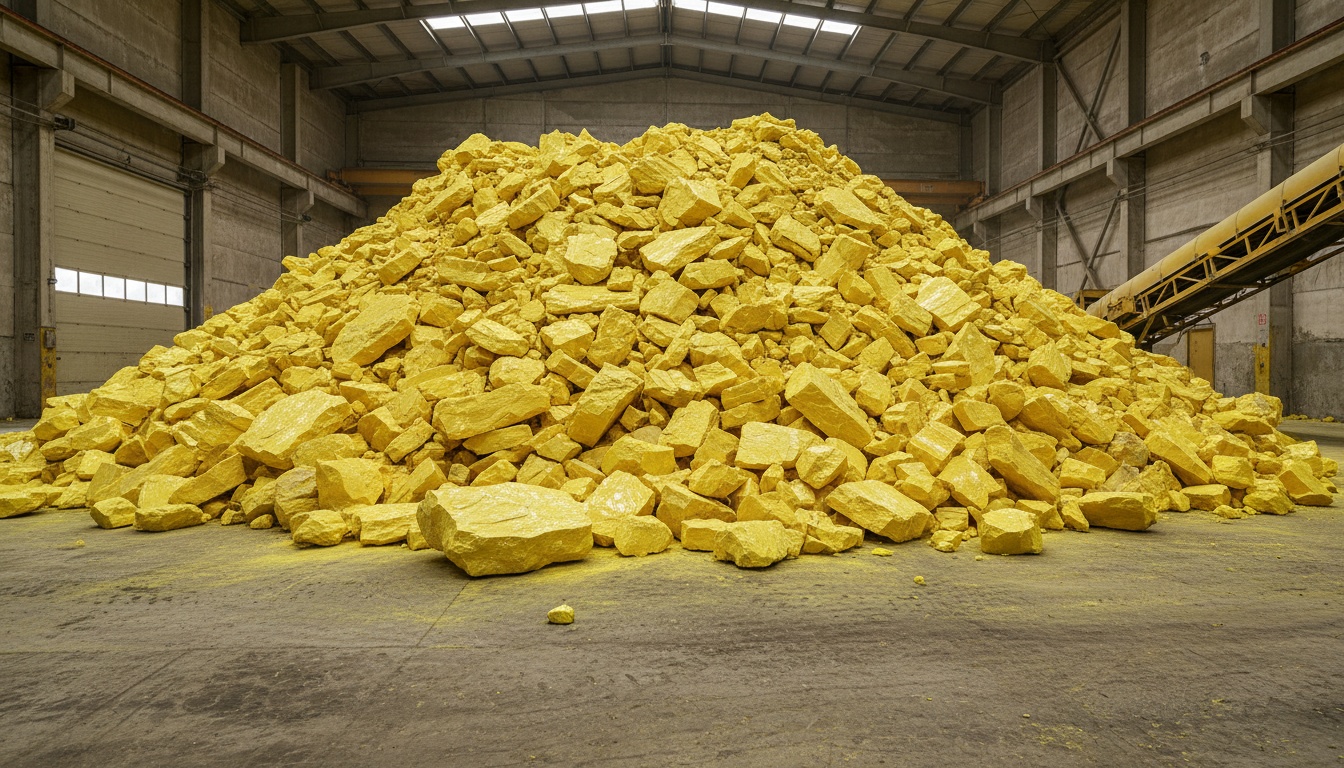
Lump sulphur is remelted block sulphur that has been broken and screened rather than formed into a bead, and the whole commercial case for it is that you skip the forming step. The chemistry is identical to granular — purity 99.8% minimum and often 99.9%, moisture ≤ 0.5%, ash ≤ 0.05%, acidity as H₂SO₄ ≤ 0.01%, organic carbon ≤ 0.05%, and arsenic, selenium and tellurium at 1 ppm or below — so an acid-plant burner cannot tell the difference once the material is molten. What differs is the physical form: irregular crushed pieces normally screened to 0–50 mm or 0–100 mm, carrying a fines fraction that formed product does not have, with bulk density around 1.2–1.3 t/m³ and an angle of repose that makes it sit and flow differently in a hold. Colour runs the same bright yellow, darkening toward honey if organic carbon creeps up, which is the one visual cue worth trusting on a hatch inspection.
Buy lump over granular when the sulphur goes straight into a melter and the discount justifies the handling. Sulphuric acid plants, phosphate fertilizer producers running DAP and MAP, mining and hydrometallurgical leach circuits and carbon-disulphide plants all melt the feed anyway, so the bead's one real advantage — clean free-flowing handling with low dust — is worth nothing to them past the port gate. Where lump costs you is exactly there: it dusts, the fines are a flammability and housekeeping problem, it does not discharge from a grab or hopper as cleanly, and a long voyage with transhipment degrades it further. That is why granular dominates the deep-sea trade while lump trades at a discount into buyers with short lanes, forgiving handling and a melter at the end. CBIL brokers crushed lump from Gulf and CIS remelt operations against SGS certification of purity, moisture, ash, acidity, carbon and screen size at load port. Supply is arranged in bulk Handysize and Supramax parcels and 1 MT jumbo bags on FOB, CFR and CIF terms — send your size cut, your melter's tolerance for fines and your discharge port and we will price against current allocation.
Indicative reference
$105–165 USD / MT
as at September 2026
Reference level only — not an offer, and reviewed quarterly. Levels shown are as at September 2026. Firm pricing is quoted per RFQ, subject to volume, terms and inspection.
Typical Specification
Specifications are indicative and adjusted to the agreed contract and destination requirements. Final spec confirmed on COA / SGS.
Available Grades
Applications
- Sulphuric acid plants
- Phosphate fertilizer (DAP / MAP)
- Mining & hydrometallurgical leaching
- Carbon disulphide production
- Sulphur remelt & forming plants
Category
Petroleum & Energy
Incoterms
FOB · CFR · CIF
Pricing basis
USD / MT
Inspection
SGS / Intertek at load port
Lump Sulphur (Crushed) — buyer questions
Is lump sulphur chemically different from granular?
No. Both are recovered elemental sulphur at 99.8% minimum purity with the same moisture, ash, acidity, carbon and trace-metal limits. The difference is purely physical — lump is crushed and screened block, granular is a formed bead. Once either is molten in your melter they are indistinguishable, which is why lump only makes commercial sense for buyers who melt.
Why is lump cheaper than granular, and is the discount real?
It is cheaper because it skips the forming step and because it dusts, carries fines and degrades over long voyages with transhipment. The discount is real but it is not free money — you pay some of it back in dust control, housekeeping and slower discharge. It is genuinely worth taking on a short lane with covered discharge and a melter downstream. On a long deep-sea lane into an open terminal, granular usually wins on delivered cost.
What size cut should I nominate?
0–50 mm and 0–100 mm are the standard screens. Nominate against your melter's charging system and your tolerance for fines — a grab or screw feeding a submerged melter handles 0–100 mm without complaint, while a smaller charging throat wants 0–50 mm. If your plant is sensitive to dust, say so up front: screening discipline varies more between remelt operations than the size label suggests, and it changes which source we work.
How are dust and flammability handled in shipping?
Sulphur dust is combustible and the fines fraction is where the risk sits, so lump moves under IMSBC Group B provisions with holds kept clean and dry, no smoking or hot work, and moisture controlled. In practice that means a covered load, screened rather than run-of-block material where your port requires it, and a moisture certificate at load. We arrange SGS quality and quantity certification at load port and can specify a tighter fines limit where your terminal insists on one.
Ready to source Lump Sulphur?
Send your quantity, specification, preferred Incoterms and destination port. We'll verify supply and respond with a workable offer — usually within one business day.
Have Lump Sulphur to sell? Submit an offer — we'll match it against live buyer demand.
More in Sulphur (Granular & Lump)
Granular Sulphur
Formed 2–6 mm granules, low friability, deep-sea grade
Prilled Sulphur
Uniform 1–4 mm prills for bagged & blended use
Sulphur Powder (Micronized)
Micronized 200–325 mesh for agriculture & rubber
Sulphur Bentonite 90%
90% S pastilles that disperse on contact with moisture
Liquid Sulphur (Molten)
Molten sulphur at 135–145°C, no forming, no dust