
Granular Sulphur
Formed 2–6 mm granules, low friability, deep-sea grade
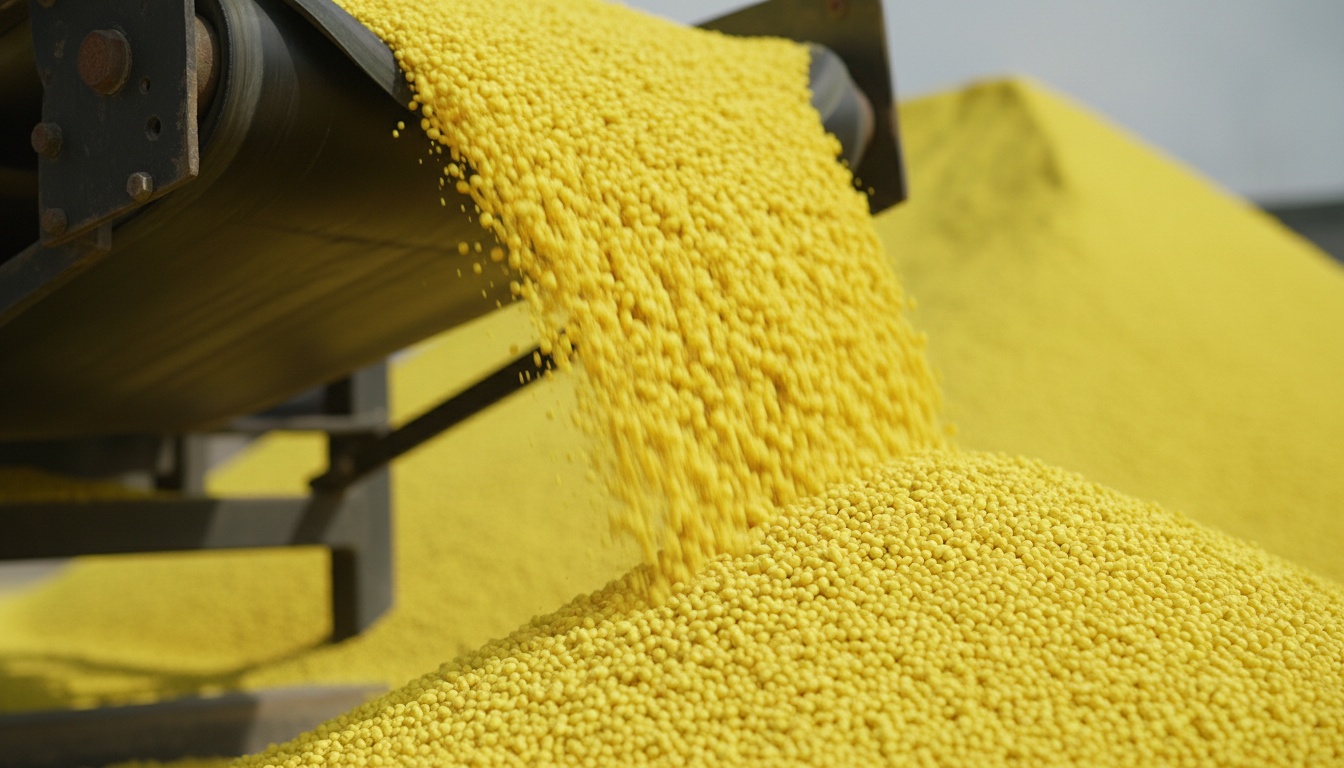
Granular sulphur is the benchmark form of the world sulphur trade, and the reason is friability rather than chemistry. Formed by wet-drum or fluid-bed granulation into rounded 2–6 mm beads, it is built to survive repeated handling: a properly formed granule stays around 5% or below on the standard friability test, where crushed lump sheds substantially more at every transfer. The chemistry is the familiar recovered-sulphur sheet — 99.8% minimum purity and commonly 99.9%, moisture ≤ 0.5%, ash ≤ 0.05%, acidity as H₂SO₄ ≤ 0.01%, organic carbon ≤ 0.05%, arsenic, selenium and tellurium each ≤ 1 ppm — with bulk density around 1.2–1.3 t/m³ and a bright yellow colour. Size distribution is what you actually contract on: typically 95% within 2–6 mm with the sub-1 mm fines capped, because fines are simultaneously the dust hazard, the flowability problem and tonnage you paid freight on but cannot cleanly discharge.
This is the form to take whenever the sulphur has to cross an ocean, sit in an open stockpile, or move through grab discharge, conveyors and multiple transhipments before it reaches a melter — which describes nearly every Gulf-to-Asia and Gulf-to-Africa acid and DAP/MAP lane. Sulphuric acid plants, phosphate fertilizer producers, mining leach operations, pulp and paper mills and industrial melters all take granular for that reason, and it is the only form most large bulk terminals will accept in volume. Against lump you are paying a forming premium for a bead that arrives intact; against prilled you are buying a tougher, less dusty particle that handles better in bulk while giving up some of the prill's uniformity. CBIL brokers granular sulphur from Saudi, Emirati, Qatari and Kazakh gas-processing and refinery streams against SGS certification of purity, moisture, ash, acidity, carbon, trace metals, screen analysis and friability at load port. Supply is arranged in bulk Handysize, Supramax and Panamax parcels and 1 MT jumbo bags on FOB, CFR and CIF terms — give us your annual tonnage and discharge port and we will structure spot or term supply against it.
Indicative reference
$115–185 USD / MT
as at September 2026
Reference level only — not an offer, and reviewed quarterly. Levels shown are as at September 2026. Firm pricing is quoted per RFQ, subject to volume, terms and inspection.
Typical Specification
Specifications are indicative and adjusted to the agreed contract and destination requirements. Final spec confirmed on COA / SGS.
Available Grades
Applications
- Sulphuric acid plants
- Phosphate fertilizer (DAP / MAP / TSP)
- Mining & leaching
- Pulp & paper
- Rubber & chemical processing
Category
Petroleum & Energy
Incoterms
FOB · CFR · CIF
Pricing basis
USD / MT
Inspection
SGS / Intertek at load port
Granular Sulphur — buyer questions
Granular or lump — which should I buy?
Decide on the lane and the handling, not the chemistry, because they are chemically the same. Granular survives long voyages, transhipment, grab discharge and open stockpiling with low fines generation; lump is cheaper per tonne but dusts, degrades and discharges more slowly. If the cargo crosses an ocean or passes through a terminal that will not tolerate dust, take granular. If you have a short lane and a melter, price both and compare delivered cost rather than headline price.
What does friability mean on a sulphur spec sheet?
It is the granule's resistance to breaking down into fines under mechanical handling, measured by a standard tumble or drop test, and a well-formed granule stays at or under about 5%. It matters because every conveyor transfer, grab and hold converts weak granules into dust that you paid freight on, cannot discharge cleanly and then have to manage as a fire and housekeeping hazard. It is the single number that separates a good granular lot from a nominally compliant one.
Do you supply on term contract as well as spot?
Yes. Acid plants and fertilizer producers generally want a term structure with a monthly lifting schedule priced off a published quarterly or monthly contract price, and that is how most Gulf allocation is sold. Spot cargoes are workable where allocation is available. Tell us your annual tonnage, discharge port and preferred pricing basis and we will structure to it.
What certification travels with the cargo?
SGS or Intertek quality and quantity certification at load port covering purity, moisture, ash, acidity, organic carbon, arsenic, selenium and tellurium, plus screen analysis and friability, with draft survey or shore-scale quantity certification at both ends. If your incoming spec is tighter than the standard sheet — a lower carbon limit and a tighter fines cap are the usual ones — tell us before we work the allocation, because it changes which source can serve you.
Ready to source Granular Sulphur?
Send your quantity, specification, preferred Incoterms and destination port. We'll verify supply and respond with a workable offer — usually within one business day.
Have Granular Sulphur to sell? Submit an offer — we'll match it against live buyer demand.
More in Sulphur (Granular & Lump)
Lump Sulphur (Crushed)
Crushed block sulphur, 99.8% min, bulk & jumbo bags
Prilled Sulphur
Uniform 1–4 mm prills for bagged & blended use
Sulphur Powder (Micronized)
Micronized 200–325 mesh for agriculture & rubber
Sulphur Bentonite 90%
90% S pastilles that disperse on contact with moisture
Liquid Sulphur (Molten)
Molten sulphur at 135–145°C, no forming, no dust