
West African Cotton
CFA zone — hand-picked, notably clean, medium staple
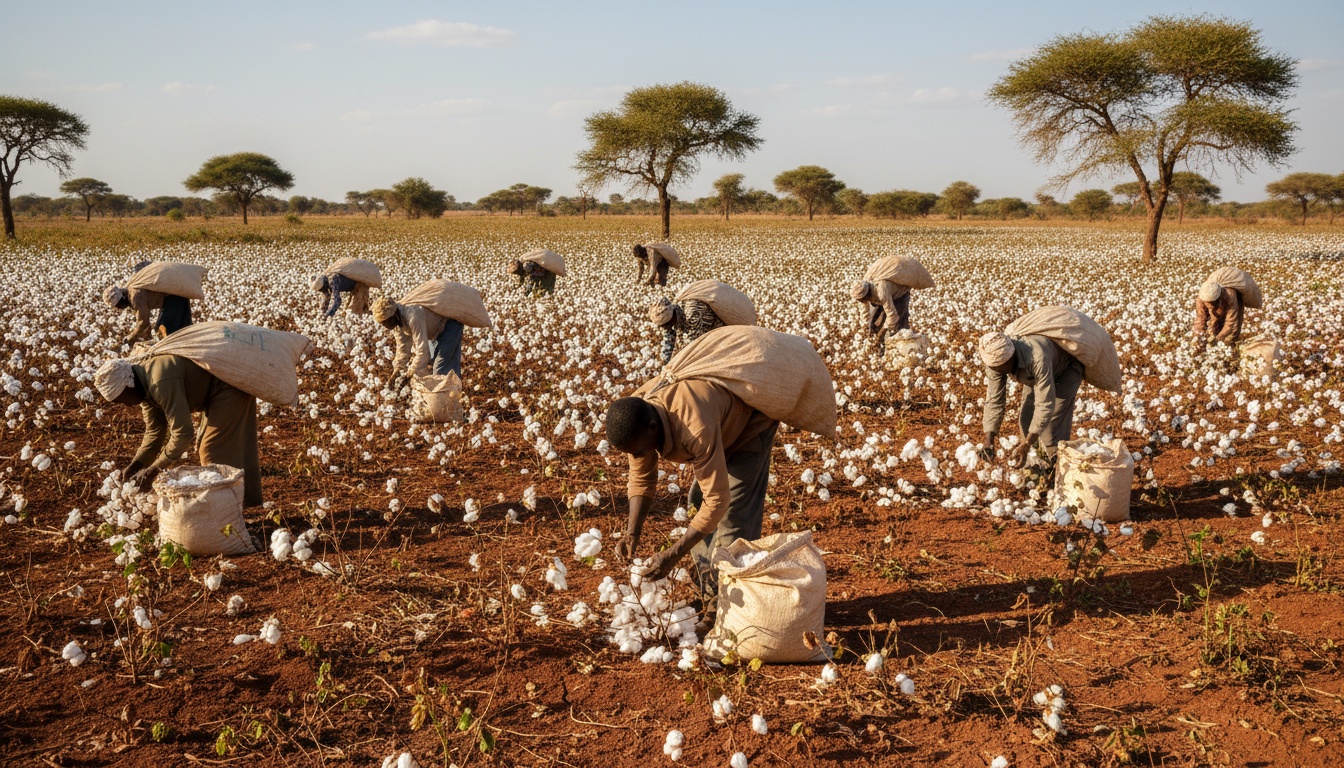
The CFA franc zone countries — Mali, Burkina Faso, Benin, Côte d'Ivoire, Chad and Cameroon — produce a medium-staple cotton that occupies a genuinely useful commercial position. It is hand-picked by smallholders, which normally implies contamination risk, yet West African lint has a markedly better contamination record than most hand-picking origins because picking is done into cotton sacks rather than synthetic ones and the parastatal ginning companies enforce reasonably consistent handling. Staple runs around 1-1/8 inch with micronaire typically 3.8 to 4.4 and strength around 28 to 30 g/tex. Grades follow local naming — Kolomba, Juli, Liptako and similar marks by country — with HVI testing increasingly standard and Cotlook quoting the origin as a recognised benchmark growth.
Buy West African cotton for medium-count spinning where you want cleaner lint than the cheapest Asian alternatives at a price well below American, and where consistent medium staple rather than exceptional length is what your system needs. It has long been a staple supply into Bangladeshi, Vietnamese and Indonesian mills for exactly that reason. Two things deserve attention in a contract. Volumes are weather-dependent and the region has had sharp production swings, so a term programme wants a named ginner rather than the origin generically. And the crop is landlocked in several producing countries, moving by road and rail to Abidjan, Lomé, Cotonou or Dakar, which adds transit time and handling steps that should be built into a shipment schedule rather than discovered. CBIL brokers West African cotton against HVI classing, grade mark, staple, micronaire, strength and ginner, on FOB Abidjan, Lomé, Cotonou and Dakar, CFR and CIF terms.
Indicative reference
$1,650–2,150 USD / MT
as at September 2026
Reference level only — not an offer, and reviewed quarterly. Levels shown are as at September 2026. Firm pricing is quoted per RFQ, subject to volume, terms and inspection.
Typical Specification
Specifications are indicative and adjusted to the agreed contract and destination requirements. Final spec confirmed on COA / SGS.
Available Grades
Applications
- Medium-count ring spinning
- Open-end spinning
- Woven fabric
- Asian mill supply programmes
- Home textiles
Category
Agri-Foods, Spices & Nuts
Incoterms
FOB · CFR · CIF
Pricing basis
USD / MT
Inspection
SGS / Intertek at load port
West African Cotton — buyer questions
Why is hand-picked West African cotton relatively clean?
Picking practice and ginning discipline. Cotton is picked into cotton sacks rather than the synthetic sacking that sheds polypropylene fibre into the lint, and the parastatal ginning companies enforce reasonably consistent handling. It is the exception that proves contamination is a supply-chain problem rather than an inevitable consequence of hand picking.
How does it compare with Indian cotton on price and quality?
Similar staple and micronaire, usually a modest premium over Indian lint, and materially cleaner. For a mill without contamination-clearing equipment that premium often pays for itself in reduced fabric faults and less downstream rework. For a mill that has invested in clearing, Indian cotton may still be the better landed economics.
Should I contract the origin or a specific ginner?
A named ginner, for anything beyond a single spot lot. Quality and handling vary between ginning companies more than between countries in this region, and production swings with the weather. Naming the ginner gives you a repeatable specification and a counterparty to hold to it.
What logistics should I plan for?
Longer inland legs than a coastal origin. Mali, Burkina Faso and Chad are landlocked, so cotton moves by road and rail to Abidjan, Lomé, Cotonou or Dakar before loading, adding transit time and handling. Build that into the shipment window explicitly and confirm the routing, because it varies with regional conditions.
Ready to source West African?
Send your quantity, specification, preferred Incoterms and destination port. We'll verify supply and respond with a workable offer — usually within one business day.
Have West African to sell? Submit an offer — we'll match it against live buyer demand.
More in Cotton
US Upland Cotton
Memphis, Texas & California growths — USDA HVI classed
Pima & Supima Cotton
American ELS — 1-3/8 inch and above, 40+ g/tex
Egyptian Giza Cotton
Giza 86, 88, 92 & 94 — hand-picked ELS from the Delta
Indian Cotton (Shankar-6)
Shankar-6, MCU-5 & DCH-32 — the volume medium staple
Brazilian Cotton
Mato Grosso & Bahia — machine-picked, low contamination
Cotton Yarn
Carded & combed, ring and open-end, Ne 10 to Ne 80