
Indian Cotton (Shankar-6)
Shankar-6, MCU-5 & DCH-32 — the volume medium staple
India grows more cotton than any other country and sells it by variety name rather than by a national grade system, which is the first thing an importing mill has to get used to. Shankar-6 from Gujarat is the most traded and the effective benchmark — roughly 1-1/8 inch staple, micronaire 3.5 to 4.5, strength around 28 to 30 g/tex. MCU-5 from the southern states runs slightly longer and finer. DCH-32 is India's extra long staple, at 1-3/8 inch and above, grown in small volume and competing with Pima and Giza. Bengal Deshi and other short-staple Asiatic varieties serve coarse-count and non-woven uses. Classing is by HVI at private and CCI facilities rather than under a single government programme, so the identity of the tester and the merchant matters more than it does with American lint.
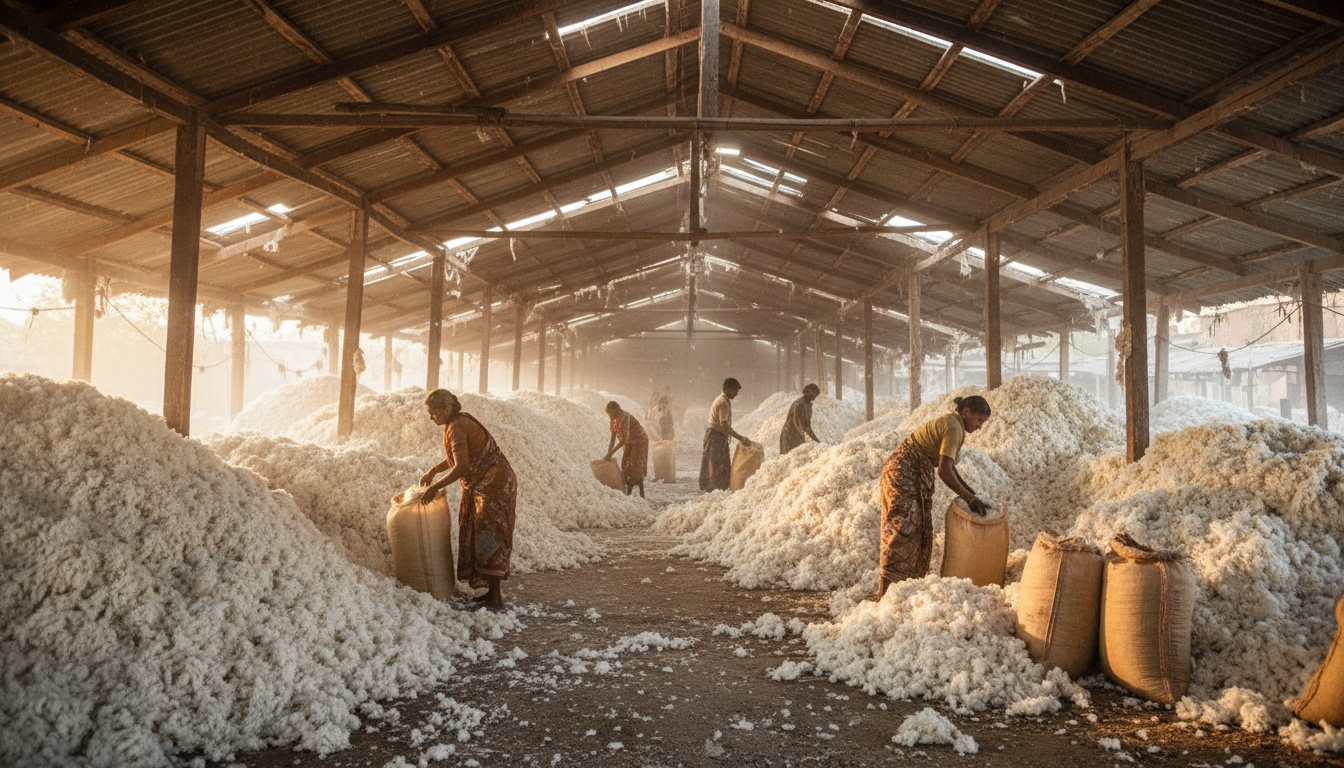
Buy Indian cotton where landed cost per kilo is the deciding metric and your spinning system tolerates some variability: open-end and coarse-to-medium count ring spinning, denim, home textiles, and any mill with the sorting and blending capability to work with mixed lots. It is consistently among the cheapest medium staple available and the volume is enormous. The honest caution is contamination and consistency. Much of the crop is hand-picked and stored in a fragmented supply chain, and Indian cotton has historically ranked poorly in the ITMF contamination survey — polypropylene, jute and hair baled with the lint, which only reveals itself as a fault in dyed fabric. A mill that has invested in contamination-clearing equipment can absorb that and capture the price advantage; one that has not should think carefully. CBIL brokers Indian cotton against variety, HVI classing, staple, micronaire, strength and trash, on FOB Mundra, Kandla and Tuticorin, CFR and CIF terms.
Indicative reference
$1,500–1,950 USD / MT
as at September 2026
Reference level only — not an offer, and reviewed quarterly. Levels shown are as at September 2026. Firm pricing is quoted per RFQ, subject to volume, terms and inspection.
Typical Specification
Specifications are indicative and adjusted to the agreed contract and destination requirements. Final spec confirmed on COA / SGS.
Available Grades
Applications
- Open-end & coarse-count spinning
- Denim
- Home textiles
- Medium-count ring spinning
- Cost-led mill programmes
Category
Agri-Foods, Spices & Nuts
Incoterms
FOB · CFR · CIF
Pricing basis
USD / MT
Inspection
SGS / Intertek at load port
Indian Cotton (Shankar-6) — buyer questions
How serious is the contamination issue?
Serious enough to price into the decision. Indian cotton has historically ranked poorly in the ITMF contamination survey — polypropylene, jute and hair baled with the lint, which passes through spinning invisibly and shows up as a fault in dyed fabric. A mill with contamination-clearing equipment can absorb it and capture the price advantage. A mill without one is buying a downstream problem.
What is Shankar-6 and why is it quoted so often?
It is the Gujarat variety that dominates Indian export trade and functions as the benchmark, roughly 1-1/8 inch staple with micronaire 3.5 to 4.5. Quoting Shankar-6 is the Indian equivalent of quoting Middling 1-1/8 in the American trade. Other varieties price as a differential to it.
Why does the merchant matter more with Indian cotton?
Because there is no single national classing programme. American bales are all USDA HVI tested under one system; Indian lots are tested at private and CCI facilities of varying rigour, so the identity and reputation of the tester and the merchant carry real weight. Buy against pre-shipment samples and a named testing house, not just a certificate.
Is DCH-32 a genuine alternative to Pima?
It is genuine ELS at 1-3/8 inch and above and it does compete, but volumes are small and consistency is more variable than American Pima. For a mill that can work with it, it offers ELS characteristics at a lower price. For a brand needing verified provenance and steady supply for a premium line, Pima or Giza remain the safer buy.
Ready to source Indian Cotton?
Send your quantity, specification, preferred Incoterms and destination port. We'll verify supply and respond with a workable offer — usually within one business day.
Have Indian Cotton to sell? Submit an offer — we'll match it against live buyer demand.
More in Cotton
US Upland Cotton
Memphis, Texas & California growths — USDA HVI classed
Pima & Supima Cotton
American ELS — 1-3/8 inch and above, 40+ g/tex
Egyptian Giza Cotton
Giza 86, 88, 92 & 94 — hand-picked ELS from the Delta
Brazilian Cotton
Mato Grosso & Bahia — machine-picked, low contamination
West African Cotton
CFA zone — hand-picked, notably clean, medium staple
Cotton Yarn
Carded & combed, ring and open-end, Ne 10 to Ne 80