
Ajwa Dates
Madinah-only origin — graded by count, skin & provenance
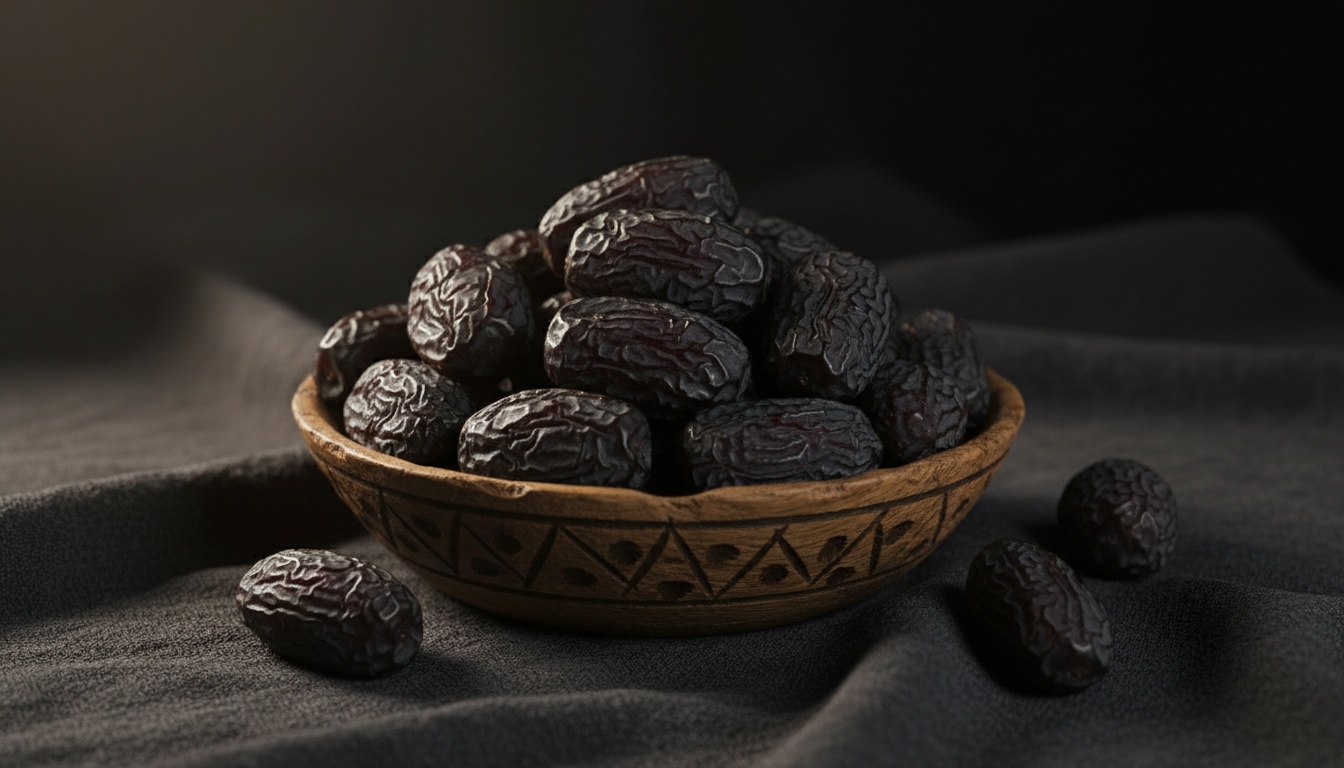
Ajwa is the one date on the Saudi list where the origin is the specification. It is cultivated commercially only in and around Madinah — the palm can be planted elsewhere, but the trade does not recognise the fruit, and no serious contract should either. The date itself is small to medium, jet black, soft-fleshed, with a fine, dense wrinkle over an intact skin; harvest runs from late July into September, and cold storage carries the crop through to the Ramadan demand peak. Revered in Islamic tradition and central to the Ramadan, Hajj and Umrah gifting trade, Ajwa prices at the very top of the Saudi market, which is precisely why its provenance is worth money and why it is the most relabelled name in the date trade. Grading turns on three variables: count per kilogramme — roughly 70 to 110 pieces across Jumbo, Large and Medium — moisture at 15–20%, and skin condition, where uniform colour and intact skin define the gift grade and blemish tolerance widens through standard export grade down to processing grade. CBIL contracts Ajwa against SGS or Intertek certification of count, moisture, foreign matter, infestation and mould, with Saudi phytosanitary and Halal documentation and — the clause that matters most on this line — farm and pack-house papers naming the Madinah source. The single-origin premium grade from the Al-Aaliya district is a separate product with its own page and its own price band.
The commercial problem with Ajwa is not quality — it is authenticity. Because the name holds a firm price floor well above every other Saudi variety, the incentive to relabel is enormous: market surveys have found a large share of online-offered 'Ajwa' to be mixed, mislabelled or dyed Khudri and Safawi, and appearance will not protect you, because a dyed date passes a photograph. Documentation protects you. Buy against named farm and pack-house origin papers, hold a sealed retention sample from loading, and treat any offer materially below the market band as a relabelling risk rather than a bargain. Buy Ajwa when the piece is presented whole and the provenance is part of the sale — Ramadan retail programmes, Hajj and Umrah gifting, premium ethnic grocery, religious gift boxes. Never buy it as an ingredient: Ajwa in a paste or a bar is the same spec error as grinding Jumbo Medjool, with a larger number attached. Timing matters as much as grade. Fresh-crop fruit lands from late summer, Ramadan demand can move the market 20–30%, and the best gift-grade lots are committed months before the season, so serious buyers fix volume in autumn rather than chasing spot. Ship reefer at 0–5 °C — the fruit tolerates short ambient legs, but chilled carriage is what holds the soft texture and even colour the gift trade is paying for. Cartons run 3, 5 and 10 kg, with 400–800 g gift formats packed at origin against your artwork.
Indicative reference
$5,500–8,500 USD / MT
as at September 2026
Reference level only — not an offer, and reviewed quarterly. Levels shown are as at September 2026. Firm pricing is quoted per RFQ, subject to volume, terms and inspection.
Typical Specification
Specifications are indicative and adjusted to the agreed contract and destination requirements. Final spec confirmed on COA / SGS.
Available Grades
Applications
- Ramadan retail programmes
- Hajj & Umrah / religious gifting
- Premium & ethnic grocery retail
- Gift boxes & festive hampers
- Fine-food e-commerce
Category
Agri-Foods, Spices & Nuts
Incoterms
FOB · CFR · CIF
Pricing basis
USD / MT
Inspection
SGS / Intertek at load port
Ajwa Dates — buyer questions
How do I know the Ajwa I am buying is genuine Madinah fruit?
Not by looking at it — a dyed Khudri photographs like Ajwa, and market surveys have found a large share of online-offered 'Ajwa' to be mixed or mislabelled. Protection is documentary: contract against Madinah farm and pack-house origin papers, take a sealed retention sample at loading, and use third-party inspection at origin rather than at destination. Price is the other filter — Ajwa holds a firm floor in the Saudi market, and an offer far below the band is almost always a different date wearing the name. We decline those offers on principle.
How is Ajwa graded?
Three variables. Count per kilogramme — roughly 70–110 pieces spanning Jumbo, Large and Medium — sets the size grade. Moisture, typically 15–20%, defines the soft eating texture buyers expect. Skin condition then separates the commercial grades: gift grade requires uniform jet-black colour with intact, finely wrinkled skin and defects under 5%; standard export grade tolerates minor blemish; processing grade takes the remainder. Specify all three on the contract. 'Ajwa, Grade A' with no numbers attached is how buyers end up arguing over a container they have already paid for.
When should I book volume for Ramadan?
Fix volume against the new crop, which lands from late July through September, and take delivery into chilled storage rather than chasing spot in the run-up to Ramadan. Seasonal demand from the gifting and pilgrimage trade can move Ajwa 20–30% in the weeks before the month begins, and the best gift-grade lots are committed early. A buyer with a Ramadan retail programme should be contracting in autumn; cold-store carry at 0–5 °C holds texture and colour comfortably across the gap.
What is the minimum order and how does it ship?
Practical minimums start at a pallet within a mixed-date consolidation, though pricing works properly from part-container upwards; a 20 ft reefer takes roughly 10–12 tonnes in export cartons. Fruit ships from Jeddah on FOB, CFR or CIF terms, reefer at 0–5 °C — Ajwa tolerates short ambient legs better than Medjool, but chilled carriage is what preserves the soft flesh and even colour the premium depends on. Retail gift formats of 400–800 g are packed at origin against your artwork, which is cheaper and cleaner than repacking in the destination market.
Ready to source Ajwa?
Send your quantity, specification, preferred Incoterms and destination port. We'll verify supply and respond with a workable offer — usually within one business day.
Have Ajwa to sell? Submit an offer — we'll match it against live buyer demand.
More in Saudi Dates
Ajwa Al Aaliya Dates
Named-farm Ajwa from Madinah's Al-Aaliya basalt belt
Anbara (Amber) Dates
Madinah's largest date — graded on count, priced on size
Safawi Dates
Madinah semi-dry, near-black, ambient-stable · FOB Jeddah
Mabroom Dates
Madinah's long date — graded on length, sold on looks
Sagai Dates
Two-tone Najd semi-dry — graded by piece weight & count
Sukkari Dates
Qassim golden Sukkari — soft (rutab) & mufattal, by count
Khalas Dates
Al-Ahsa amber semi-dry, 60–90 count, ambient-stable
Khudri Dates
Semi-dry Saudi volume date — size-graded, year-round FCL
Saudi Medjool Dates
AlUla & Al-Jouf Medjool by calibre and skin grade
Barni Dates
Semi-dry Madinah date — Grade 1/2, Al-Ais provenance
Shalabi Dates
Scarce Madinah variety — lot-certified, part-load supply
Rabia Dates
Madinah value date graded on count, moisture and defects
Mashrooq Dates
Mid-tier Madinah date — caramel-sweet, sold by count band
Stuffed & Chocolate Dates
Stuffed & enrobed OEM lines · 18–20°C chocolate cool chain