
Ajwa Al Aaliya Dates
Named-farm Ajwa from Madinah's Al-Aaliya basalt belt
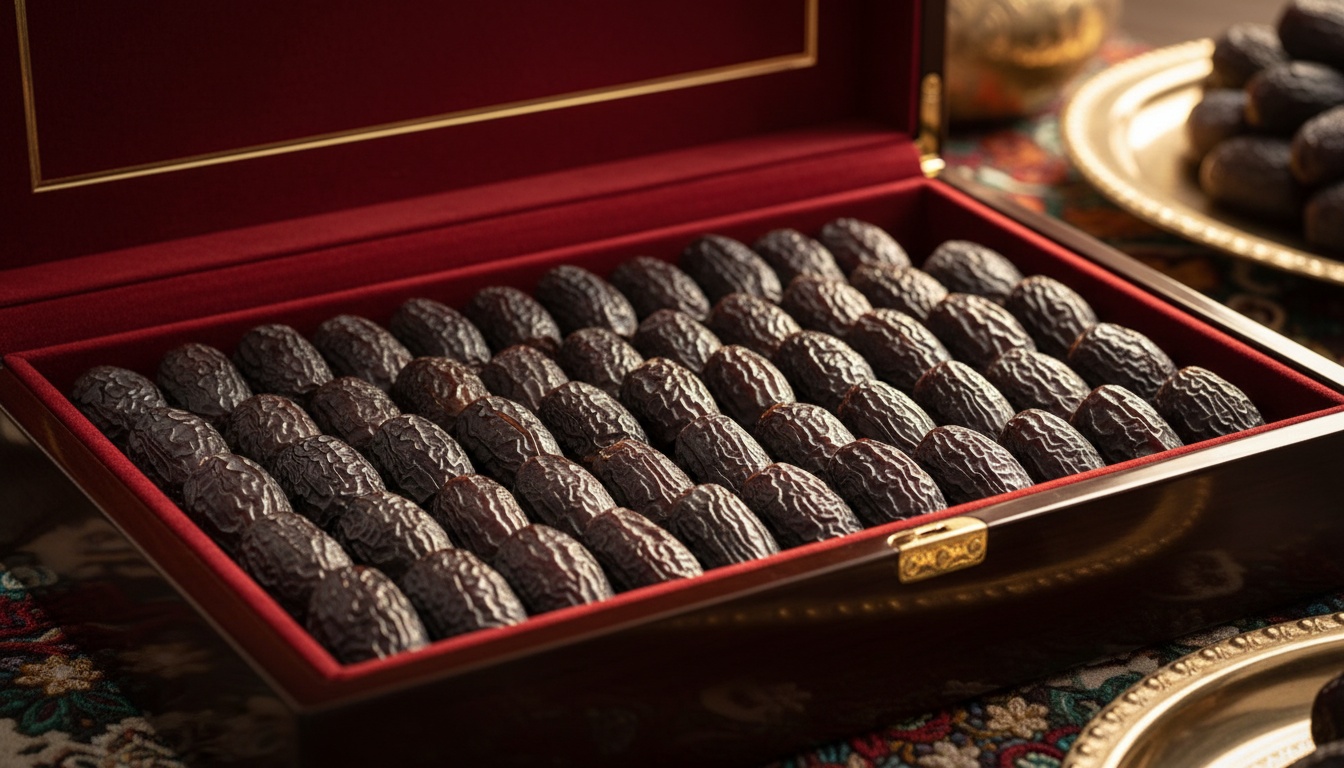
Al-Aaliya (العالية) is the elevated southern farm belt of Madinah — the district rising through Quba and Al-Awali onto the black basalt of ancient lava fields — and within a variety already defined by a single city, it is the one district the Madinah trade itself ranks first. The market prices that opinion: Aaliya fruit is the reference against which all other Ajwa is discounted. The difference is physical and consistent. Aaliya-grown fruit runs darker — an even jet black without brown patching — smaller and tighter in the hand, softer in the flesh, with a noticeably finer, denser wrinkle than valley-grown Ajwa, and the flavour carries the restrained sweetness and faintly mineral depth the trade attributes to the basalt soils. Farm plots in the district are small, long-held and rarely sold, harvest is short, and total output is a modest fraction of overall Ajwa volume — the scarcity is agronomic, not manufactured. Grading uses the standard Ajwa variables, count per kilogramme (typically 90–120, since the fruit is smaller), moisture and skin condition, but the controlling specification is the farm itself: genuine lots are bought against named farms and pack-houses inside the Aaliya boundary. CBIL contracts the grade with SGS or Intertek certification of count, moisture, foreign matter and infestation alongside farm-level traceability, Saudi phytosanitary documentation and Halal certification, with the district named in the origin papers rather than only on the carton.
Whether the Aaliya premium pays depends entirely on whether your customer knows the word. In Madinah retail the district's fruit holds around SAR 50 per kilogramme while respected mid-market varieties such as Safawi and Sagai trade in the low twenties — roughly double for the district name — and standard Ajwa sits between the two. That premium survives export only where the end buyer recognises Aaliya by name: top-end religious gifting, luxury Ramadan hampers, corporate gifting into Gulf and South Asian diaspora markets, and speciality retailers serving an informed Muslim clientele. Sold to a customer whose vocabulary stops at 'Ajwa', the district is invisible and standard Madinah Ajwa is the correct buy — that boundary is the whole difference between this page and our main Ajwa line. Verification is stricter here than anywhere else in the date trade because the fraud is double-layered: non-Madinah fruit sold as Ajwa, and valley Ajwa sold as Aaliya. Contract against named farms, require the district on the origin documents, buy in or near harvest season while farm-direct lots remain identifiable, and benchmark every offer — genuine Aaliya at standard-Ajwa money is not a discount, it is a label. Volumes are gift-trade volumes: 400–800 g boxes and 1–3 kg presentation formats dominate, part-container orders consolidated with other date lines are normal, and reefer carriage at 0–5 °C is non-negotiable for fruit this soft. For Ramadan programmes, allocations are fixed at harvest.
Indicative reference
$8,000–12,000 USD / MT
as at September 2026
Reference level only — not an offer, and reviewed quarterly. Levels shown are as at September 2026. Firm pricing is quoted per RFQ, subject to volume, terms and inspection.
Typical Specification
Specifications are indicative and adjusted to the agreed contract and destination requirements. Final spec confirmed on COA / SGS.
Available Grades
Applications
- Luxury religious & corporate gifting
- Top-end Ramadan hampers
- Speciality retail (single-origin lines)
- Pilgrimage gifting trade
- Fine-food e-commerce
Category
Agri-Foods, Spices & Nuts
Incoterms
FOB · CFR · CIF
Pricing basis
USD / MT
Inspection
SGS / Intertek at load port
Ajwa Al Aaliya Dates — buyer questions
What actually distinguishes Aaliya fruit from standard Madinah Ajwa?
Physically: consistently darker fruit — an even jet black without brown patching — smaller and tighter, with softer flesh and a finer, denser wrinkle than valley-grown Ajwa. The Madinah trade attributes the difference to the district's elevated black basalt soils around Quba and Al-Awali, and ranks Aaliya first among Ajwa origins. Commercially: the market prices that ranking — Aaliya fruit holds roughly SAR 50 per kilogramme in Madinah retail while respected mid varieties trade in the low twenties. It is a district grade of the same variety, not a different date.
How do I verify a lot is genuinely from Al-Aaliya farms?
Insist the district appears on the origin documentation, not merely on the carton — genuine lots trace to named farms and pack-houses inside the Aaliya boundary, and a seller who cannot name the farm is selling you standard Ajwa at best. Buy in or shortly after harvest season, when farm-direct lots are still identifiable, and benchmark the price: the district's output is small and its floor is firm, so 'Aaliya' offered at ordinary Ajwa money is a label, not a discount. We contract with the farm name in the documents and third-party inspection at origin.
Who should pay the Aaliya premium — and who should not?
Pay it when your end customer recognises the name. Top-end religious gifting, luxury Ramadan hampers, Gulf and diaspora corporate gifting and speciality retail with an informed Muslim clientele will all return the premium, because those buyers ask for Aaliya specifically and check for it. If your customer's vocabulary stops at 'Ajwa', the district is invisible on your shelf and standard Madinah Ajwa is the correct buy — same variety, same city, meaningfully less money. The premium is a provenance story, and it only pays where the story is heard.
How is it packed and what is the minimum order?
This is a gift-trade product and it ships like one: 400–800 g boxes and 1–3 kg presentation formats packed at origin, palletised into reefer carriage at 0–5 °C. Part-container orders consolidated with other date lines are normal — district output is too small for anyone to be moving full containers of genuine Aaliya routinely, and an offer of large monthly volume should itself raise questions. Fruit ships from Jeddah on FOB, CFR or CIF terms. For Ramadan programmes, commit at harvest; the best farm lots are allocated months before the season.
Ready to source Ajwa Al Aaliya?
Send your quantity, specification, preferred Incoterms and destination port. We'll verify supply and respond with a workable offer — usually within one business day.
Have Ajwa Al Aaliya to sell? Submit an offer — we'll match it against live buyer demand.
More in Saudi Dates
Ajwa Dates
Madinah-only origin — graded by count, skin & provenance
Anbara (Amber) Dates
Madinah's largest date — graded on count, priced on size
Safawi Dates
Madinah semi-dry, near-black, ambient-stable · FOB Jeddah
Mabroom Dates
Madinah's long date — graded on length, sold on looks
Sagai Dates
Two-tone Najd semi-dry — graded by piece weight & count
Sukkari Dates
Qassim golden Sukkari — soft (rutab) & mufattal, by count
Khalas Dates
Al-Ahsa amber semi-dry, 60–90 count, ambient-stable
Khudri Dates
Semi-dry Saudi volume date — size-graded, year-round FCL
Saudi Medjool Dates
AlUla & Al-Jouf Medjool by calibre and skin grade
Barni Dates
Semi-dry Madinah date — Grade 1/2, Al-Ais provenance
Shalabi Dates
Scarce Madinah variety — lot-certified, part-load supply
Rabia Dates
Madinah value date graded on count, moisture and defects
Mashrooq Dates
Mid-tier Madinah date — caramel-sweet, sold by count band
Stuffed & Chocolate Dates
Stuffed & enrobed OEM lines · 18–20°C chocolate cool chain