
Ethiopia Arabica
Yirgacheffe, Sidamo & Guji — G1/G2, washed & natural
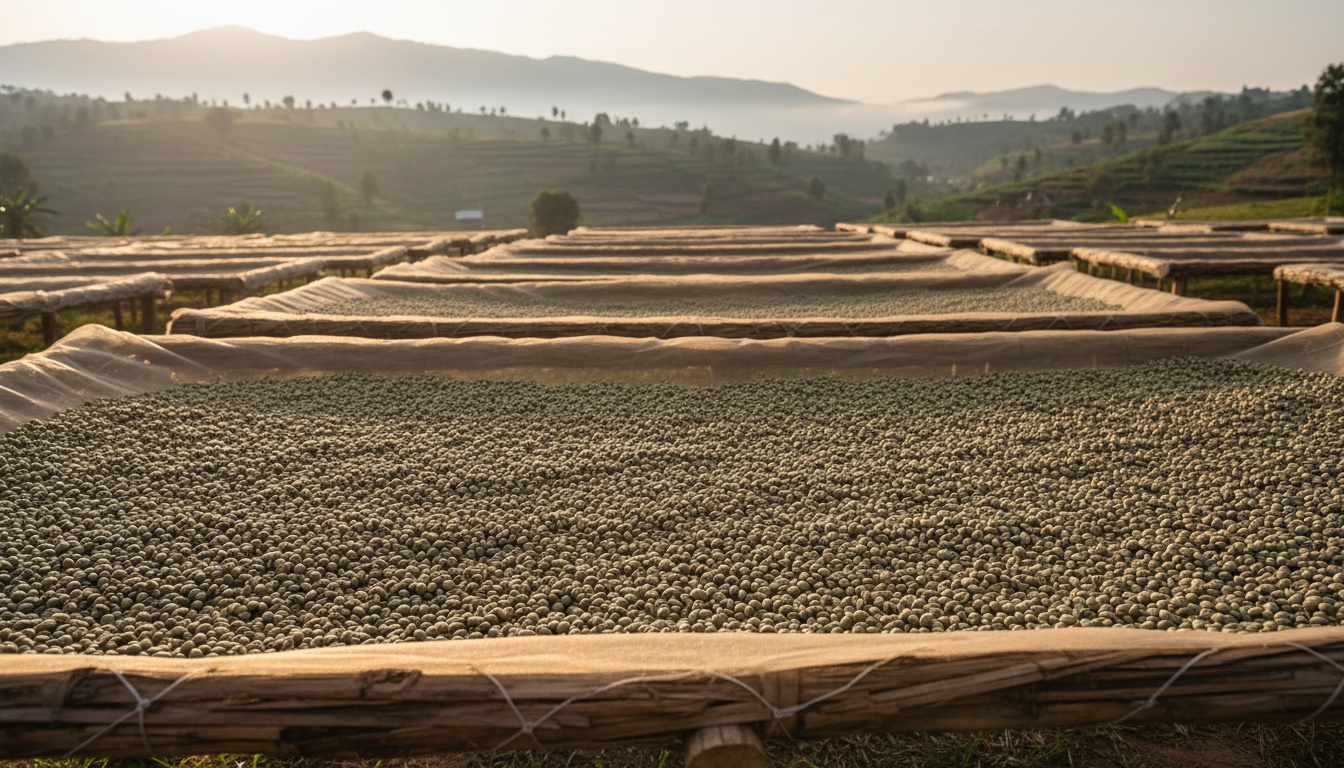
Ethiopia is the botanical home of arabica and its coffee is graded by defect count on a scale where Grade 1 and Grade 2 are the specialty export tiers — G1 permitting very few defects, G2 slightly more, with grades below that moving into commercial and domestic channels. Washing station and zone matter more here than in any other origin: Yirgacheffe is the benchmark for delicate floral and citrus character, Sidamo broader and often more rounded, Guji increasingly prized for intense fruit, Limu and Djimmah more commercial in profile. Process splits the offer in two — washed lots are clean, tea-like, jasmine and bergamot; naturals, dried in the cherry, are heavier with blueberry and strawberry fruit character. Ethiopian heirloom varieties are genetically diverse landraces rather than a named cultivar, which is a large part of why the cup is distinctive and impossible to replicate elsewhere.
This is the origin to buy when the cup is the product: single-origin filter and pour-over programmes, specialty retail bags sold on tasting notes, competition and flagship offerings, and the aromatic top note in a premium blend. It is the wrong purchase for a commercial espresso base or a soluble line, where the price is several times what Brazil costs and the delicate character is destroyed by dark roasting anyway. Two practical cautions. Grade alone under-describes Ethiopian coffee — a G1 from a weak washing station can disappoint against a G2 from a strong one, so buy on cup score and station name, not the grade number. And Ethiopian export has moved through several regulatory regimes, from ECX auction to direct-specialty routes, so traceability and documentation vary considerably by seller. CBIL brokers Ethiopian arabica against cup score, grade, screen, moisture, water activity and station traceability, on FOB Djibouti, CFR and CIF terms.
Indicative reference
$8,500–14,000 USD / MT
as at September 2026
Reference level only — not an offer, and reviewed quarterly. Levels shown are as at September 2026. Firm pricing is quoted per RFQ, subject to volume, terms and inspection.
Typical Specification
Specifications are indicative and adjusted to the agreed contract and destination requirements. Final spec confirmed on COA / SGS.
Available Grades
Applications
- Single-origin filter & pour-over
- Specialty retail bags
- Competition & flagship lots
- Aromatic top note in blends
- Cold brew specialty
Category
Agri-Foods, Spices & Nuts
Incoterms
FOB · CFR · CIF
Pricing basis
USD / MT
Inspection
SGS / Intertek at load port
Ethiopia Arabica — buyer questions
Is Grade 1 always better than Grade 2?
No, and treating it that way is the classic Ethiopian buying error. The grade is a defect count, not a cup score. A G1 from a weak washing station can disappoint next to a G2 from a strong one, because what drives the cup here is zone, station and processing care. Buy on cup score and station name, with grade as a secondary filter.
Washed or natural Yirgacheffe?
Different products for different programmes. Washed gives the clean, floral, tea-like jasmine and bergamot profile that made the name — the classic filter cup. Naturals are dried in the cherry and come out heavier and fruit-forward, blueberry and strawberry, which sells strongly in specialty retail but polarises. If you are launching a single-origin, decide which story you are telling before you buy.
What are heirloom varieties?
Ethiopia's coffee is a genetically diverse population of indigenous landraces rather than named cultivars like Caturra or Bourbon, so lots are described simply as heirloom. That diversity is a real part of why the cup is distinctive and why it cannot be reproduced by planting Ethiopian seed elsewhere. It also means variety-level consistency is lower than in Latin America.
How reliable is traceability?
It varies more than at most origins, because Ethiopian export has passed through several regulatory regimes and lots may route via auction or via direct specialty channels. Station-level traceability is achievable and worth insisting on if you are selling on provenance, but it needs to be contracted explicitly rather than assumed. Ask us what level of traceability a given lot actually carries.
Ready to source Ethiopia Arabica?
Send your quantity, specification, preferred Incoterms and destination port. We'll verify supply and respond with a workable offer — usually within one business day.
Have Ethiopia Arabica to sell? Submit an offer — we'll match it against live buyer demand.
More in Green Coffee Beans
Brazil Arabica (Santos)
Santos NY 2/3, screen 17/18, natural & pulped natural
Colombia Arabica (Supremo & Excelso)
Supremo scr 17/18 & Excelso scr 14/16, fully washed
Vietnam Robusta
Grade 1 scr 18 & Grade 2 scr 13, 5% black & broken
Uganda Robusta
Screen 18 natural robusta — cleaner cup than Asian origin
Central America Arabica (SHG / SHB)
Honduras, Guatemala & Nicaragua — SHG/SHB, EP washed
India Coffee (Plantation & Monsooned)
Plantation A, Cherry AB & Monsooned Malabar