
Dehydrated Garlic
Flakes, granules and powder graded on allicin and colour
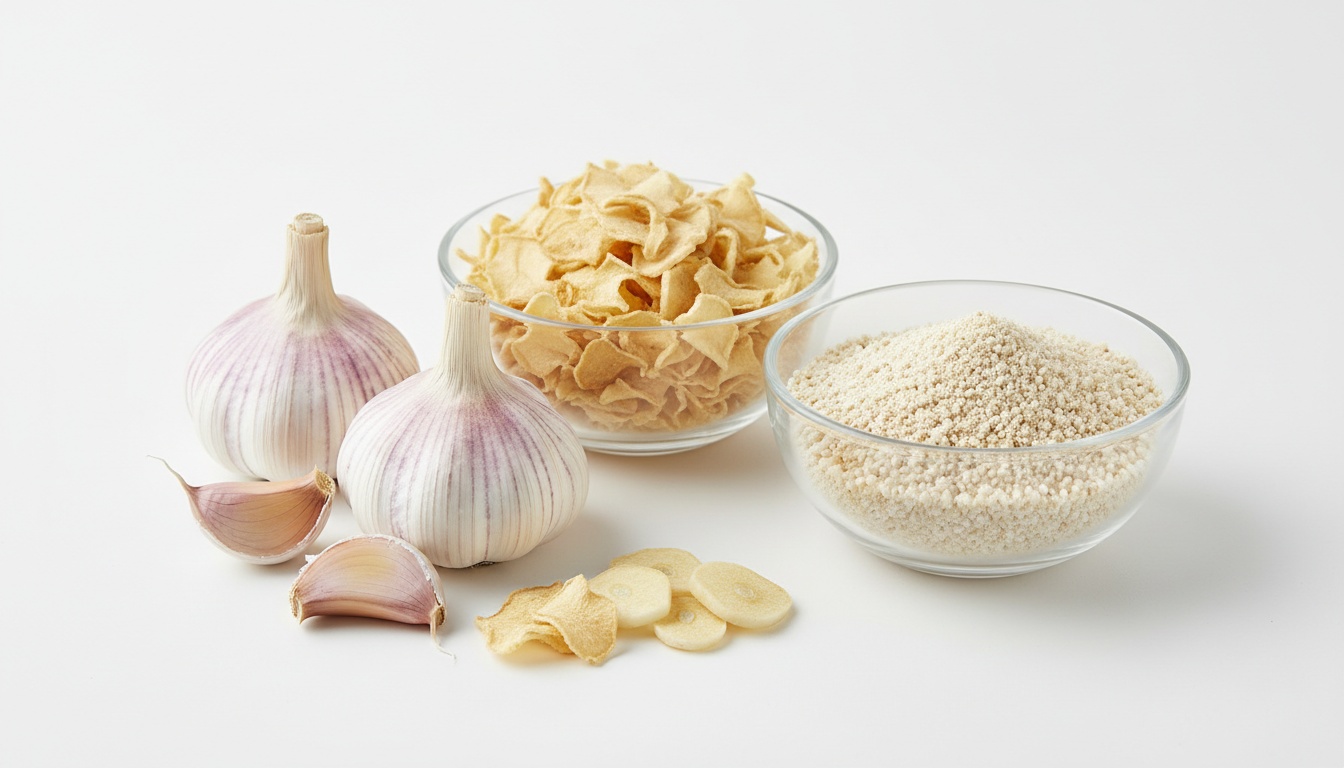
CBIL arranges supply of dehydrated garlic from Gujarat's Mahuva belt and other Indian processing hubs, plus Chinese and Egyptian origins, in the standard cuts: flakes (whole dried cloves, roughly 15–40 mm), minced (1–3 mm), granules (20–40 and 40–60 mesh) and powder at 80–100 mesh. Garlic behaves differently from onion in the dryer and that shapes the specification. It is far more heat-sensitive: dry it too hard and the allicin-derived pungency that you are buying it for collapses, while the colour goes from clean white to cream and then to the yellow-brown that a QA panel rejects on sight. Root and skin content is the other grading variable that separates lots — dark specks in a white powder are the visible tell of poorly trimmed cloves, and root-and-skin-free grades carry a premium precisely because that is what your customer sees in the finished dust.
Buyers choose garlic over onion when they want the sharper, more assertive note that garlic contributes at a fraction of the inclusion rate — which is exactly why it prices well above dehydrated onion per tonne but often costs less per unit of flavour delivered. Flakes suit visible applications and buyers who mill on their own line; granules are the workhorse for seasoning blends and instant noodles; powder is the snack-coating and sauce base. Garlic carries a higher inherent microbiological load than onion, so Salmonella-absent certification is not optional for most food-safety programmes. Product is metal-detected and sieve-graded to your mesh, arranged against SGS certification of moisture, SO₂, ash, colour, root and skin content and micro — total plate count, yeast and mould, Salmonella absent in 25 g, E. coli — with ETO-free and steam-sterilised formats for EU and US entry, since ETO-treated material cannot enter the EU. Supply is structured in 10kg and 20kg lined cartons and fibre drums, container-load, on FOB, CFR and CIF terms.
Indicative reference
$1,900–2,400 USD / MT
as at September 2026
Reference level only — not an offer, and reviewed quarterly. Levels shown are as at September 2026. Firm pricing is quoted per RFQ, subject to volume, terms and inspection.
Typical Specification
Specifications are indicative and adjusted to the agreed contract and destination requirements. Final spec confirmed on COA / SGS.
Available Grades
Applications
- Seasoning blends
- Snack coatings
- Instant noodles & soups
- Sauces & ready meals
- Retail packing
Category
Agri-Foods, Spices & Nuts
Incoterms
FOB · CFR · CIF
Pricing basis
USD / MT
Inspection
SGS / Intertek at load port
Dehydrated Garlic — buyer questions
Why is my dehydrated garlic powder speckled?
Root and skin carry-over from poorly trimmed cloves. It is invisible in flakes and obvious in a white powder, which is why root-and-skin-free grades carry a premium. If your product is a visible white dust, specify the root-and-skin-free grade at contract stage — you cannot sort it out after milling.
Why does garlic cost so much more than dehydrated onion?
Per tonne, yes — garlic prices well above onion. But garlic delivers its note at a fraction of the inclusion rate, so per unit of flavour in the finished product it is frequently the cheaper ingredient. Compare the two on your actual formulation cost rather than on the per-tonne number.
Does drying temperature affect dehydrated garlic?
More than it does onion. Garlic is heat-sensitive: pushed too hard in the dryer it loses the pungency you are buying it for and the colour drifts from white through cream to yellow-brown. Colour is the reliable visual tell — if a sample looks cream rather than clean white, ask about the drying profile before you contract the lot.
Do you supply ETO-free dehydrated garlic?
Yes, and for the EU it is the only option — ETO-treated material cannot enter. We default to steam-sterilised or ETO-free garlic for European destinations with micro certification including Salmonella absent in 25 g. Garlic carries a higher baseline micro load than onion, so this is worth writing into the contract rather than assuming.
Ready to source Dehydrated Garlic?
Send your quantity, specification, preferred Incoterms and destination port. We'll verify supply and respond with a workable offer — usually within one business day.
Have Dehydrated Garlic to sell? Submit an offer — we'll match it against live buyer demand.